
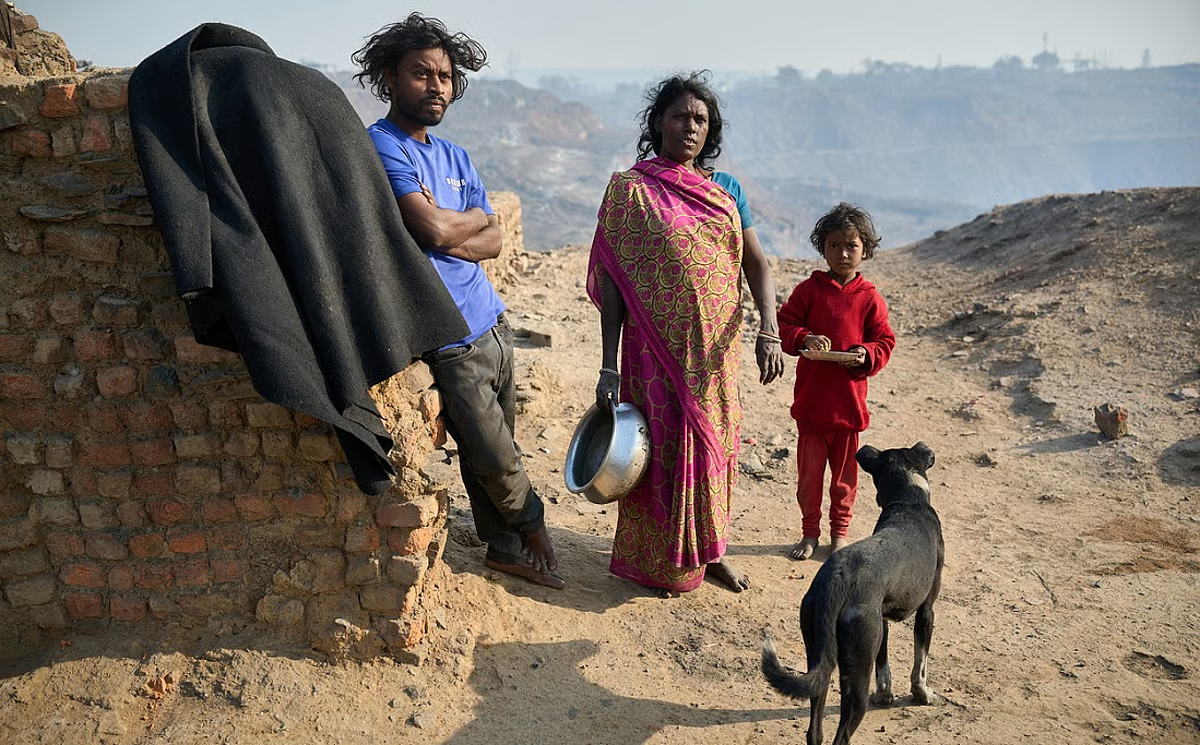
Ranchi: In a significant development for one of India’s largest coal-producing states, the Central Government has informed Parliament that 6,591 families displaced by coal mining projects in Jharkhand have been rehabilitated over the past five years, with financial assistance amounting to ₹1,108 crore. The announcement has once again brought into focus the complex relationship between industrial development, energy security and the rights of communities whose lives are transformed by mining activities.
As India continues to increase domestic coal production to meet growing electricity demand and reduce dependence on imports, Jharkhand remains at the heart of the country’s energy economy. The state is home to some of India’s richest coal reserves and contributes significantly to national coal output through companies such as Coal India Limited and its subsidiaries, including Central Coalfields Limited (CCL), Bharat Coking Coal Limited (BCCL) and Eastern Coalfields Limited (ECL).
While coal mining has strengthened the economy, generated employment and supported industrial expansion, it has also resulted in the displacement of thousands of families. For many residents living in coal-bearing regions, development has brought both opportunity and hardship. The latest rehabilitation figures have therefore sparked renewed discussions on whether compensation alone is sufficient or whether long-term livelihood restoration should become the primary objective.
Government Highlights Rehabilitation Efforts
According to information presented in Parliament, 6,591 project-affected families have been rehabilitated between 2021 and 2026, with a total rehabilitation expenditure of ₹1,108 crore.
The rehabilitation process generally includes financial compensation, housing assistance, infrastructure development in resettlement colonies and livelihood support in accordance with the applicable rehabilitation and land acquisition policies.
Officials maintain that rehabilitation remains an integral part of every major coal mining project. Before land acquisition is completed, project developers are expected to assess the impact on local communities and prepare rehabilitation plans aimed at reducing social disruption.
The latest figures indicate that substantial financial resources have been committed towards these efforts. However, rehabilitation is often judged not by the amount spent but by the quality of life experienced by affected families after relocation.
Why Jharkhand Is Central to India’s Coal Economy
Jharkhand possesses one of India’s largest coal reserves and continues to play a crucial role in powering thermal power plants, steel manufacturing and heavy industries.
Major coalfields across districts such as Dhanbad, Bokaro, Ramgarh, Hazaribagh, Chatra, Latehar and Giridih supply fuel to industries across the country.
The state’s mining sector supports thousands of direct jobs while also creating indirect employment in transportation, equipment maintenance, logistics, engineering services and local commerce.
Coal royalty, taxes and mining-related economic activity contribute significantly to both state revenue and regional development. Infrastructure such as roads, railway lines and industrial townships has expanded alongside mining operations.
However, the same projects often require acquisition of agricultural land, forests and residential settlements, creating difficult choices for affected communities.
The Human Cost of Mining Expansion
Every mining project affects more than land ownership.
Families may lose agricultural fields that have sustained them for generations. Small businesses often face relocation. Cultural and religious sites may require shifting, while traditional village networks can be disrupted permanently.
For tribal and rural communities, land frequently represents not only an economic resource but also a cultural identity connected to ancestral heritage.
Relocation therefore involves social adjustment in addition to financial compensation.
Experts in rehabilitation emphasize that successful resettlement should restore, and ideally improve, living standards rather than merely compensate for physical assets lost during land acquisition.
Rehabilitation Beyond Compensation
Modern rehabilitation policies increasingly focus on comprehensive development rather than one-time payments.
A successful rehabilitation programme generally seeks to provide:
- Secure residential housing
- Basic healthcare facilities
- Schools for children
- Reliable drinking water
- Electricity
- Road connectivity
- Livelihood opportunities
- Skill development programmes
- Employment support wherever feasible
Several mining companies have also expanded Corporate Social Responsibility (CSR) initiatives in surrounding communities by supporting education, healthcare, sanitation and vocational training.
While such initiatives contribute positively, experts argue that sustained economic opportunities remain the most important factor determining rehabilitation success.
Employment Expectations Continue to Grow
One of the biggest expectations among project-affected families is employment.
Many residents believe that acquisition of ancestral land should result in stable employment opportunities for younger generations.
Although mining projects create jobs during construction and operations, recruitment increasingly requires technical qualifications and specialized skills due to mechanisation and automation.
As a result, governments and mining companies have expanded skill development programmes aimed at preparing local youth for employment in mining operations, maintenance, safety, logistics, heavy machinery operation and other industrial sectors.
Industry experts believe that integrating vocational training into rehabilitation programmes can significantly improve long-term outcomes.
Interesting Reads
₹1,108 Crore Assistance for Coal Project-Affected Families
Latehar Coal Mining Expansion: Tubed and North Dhadu Projects Explained
Environmental Considerations Remain Important
Mining projects also raise environmental concerns that continue to shape public discussions.
Common issues include:
- Dust pollution
- Water management
- Land degradation
- Mine overburden disposal
- Forest diversion
- Air quality
- Biodiversity conservation
Modern mining regulations require environmental impact assessments, pollution control measures and mine closure plans.
Increasingly, companies are investing in afforestation, water conservation, solar energy projects and scientific reclamation of mined land to reduce long-term environmental impacts.
Balancing industrial production with environmental sustainability remains one of Jharkhand’s most significant policy challenges.
Impact on Regional Development
Despite challenges, mining has transformed several districts into major industrial centres.
Coal production has encouraged investment in:
- Rail infrastructure
- Highways
- Power generation
- Steel manufacturing
- Engineering industries
- Warehousing
- Urban development
Industrial growth has also improved demand for educational institutions, hospitals, retail markets and housing.
Many experts argue that if rehabilitation is implemented effectively, project-affected communities should become active beneficiaries of regional economic growth rather than passive observers.
Challenges That Still Need Attention
Although rehabilitation expenditure has crossed ₹1,108 crore, several challenges continue to require policy attention.
These include:
- Faster processing of compensation claims.
- Transparent land valuation mechanisms.
- Timely construction of rehabilitation colonies.
- Better livelihood restoration programmes.
- Improved public consultation during project planning.
- Continuous monitoring after relocation.
- Enhanced access to healthcare and education.
- Greater participation of local communities in decision-making.
Addressing these issues could strengthen public confidence in future infrastructure and mining projects.
Government’s Long-Term Vision
India’s growing energy requirements continue to drive expansion in domestic coal production.
The government has repeatedly emphasized increasing coal output while simultaneously improving environmental standards and rehabilitation practices.
Future policy is expected to focus on:
- Scientific mining
- Digital land records
- Transparent compensation systems
- Technology-driven environmental monitoring
- Sustainable rehabilitation models
- Skill development for displaced youth
- Integrated regional development
Such reforms could help reduce conflicts while ensuring that industrial development benefits surrounding communities more equitably.
What This Means for Jharkhand
For Jharkhand, the announcement represents more than a financial statistic.
The rehabilitation of 6,591 families reflects the enormous social transformation occurring alongside industrial expansion. Every new mine brings economic opportunity, but it also requires careful planning to ensure that affected communities receive lasting benefits.
If rehabilitation programmes continue evolving beyond compensation towards education, employment, healthcare and entrepreneurship, displaced families could become active participants in Jharkhand’s economic future.
At the same time, continued transparency, community participation and effective implementation will remain essential to maintaining public trust.
Conclusion
Jharkhand’s future is closely linked to its mineral wealth. Coal will continue to play a critical role in India’s energy security for years to come, making the state an indispensable part of the national economy.
The announcement that ₹1,108 crore has been spent on rehabilitating 6,591 project-affected families demonstrates a substantial investment in addressing the social impact of mining. However, the true measure of success will not be determined solely by expenditure figures.
Success will ultimately depend on whether displaced families gain sustainable livelihoods, quality education, modern infrastructure and improved standards of living after relocation.
As mining projects continue expanding across Jharkhand, rehabilitation will remain one of the defining challenges—and opportunities—for policymakers, industry leaders and local communities alike. Striking the right balance between economic growth and social justice will determine whether the state’s vast mineral wealth becomes a foundation for inclusive development or a continuing source of public concern.
