
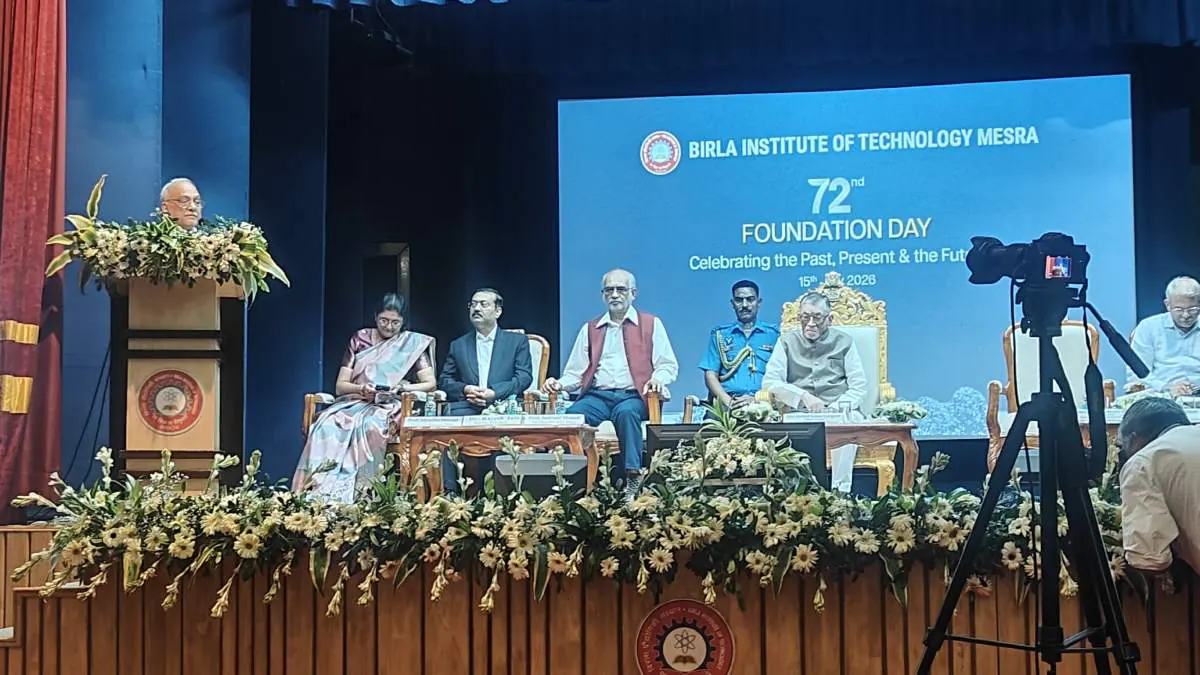
BIT Mesra Foundation Day: Governor Calls for AI, Startups and Research to Shape Jharkhand’s Future
Governor Santosh Kumar Gangwar highlights AI, robotics, semiconductors, cybersecurity and startups as key pillars for Jharkhand’s future development.
As the world enters a new era driven by Artificial Intelligence (AI), robotics, quantum computing, semiconductors, cybersecurity, green energy, and digital transformation, Jharkhand is positioning itself to become an active participant in India’s technological revolution. Addressing the 72nd Foundation Day celebrations of Birla Institute of Technology (BIT), Mesra, Jharkhand Governor Santosh Kumar Gangwar emphasized that technical institutions must evolve beyond their traditional role of imparting education and emerge as powerful centres for innovation, research, entrepreneurship, startups, and technology-driven solutions.
His remarks come at a crucial time when India is implementing ambitious national initiatives such as Viksit Bharat 2047, Atmanirbhar Bharat, Startup India, Digital India, Make in India, Skill India, and the IndiaAI Mission. These programmes are reshaping the country’s innovation ecosystem while encouraging states like Jharkhand to harness technology for inclusive economic development.
For Jharkhand—a state known for its rich mineral resources, industrial base, forests, and growing educational infrastructure—the Governor’s vision highlights the potential to transform into a hub for technology-enabled industries, research, and startup innovation.
Technology Education Beyond Classrooms
Governor Gangwar stressed that technical institutions can no longer limit themselves to classroom education. Instead, engineering colleges, universities, and research institutions must actively contribute to solving real-world challenges through innovation.
Today’s graduates are expected to develop solutions in sectors such as:
- Artificial Intelligence
- Robotics
- Semiconductor Design
- Green Energy
- Cybersecurity
- Data Science
- Internet of Things (IoT)
- Smart Manufacturing
- Renewable Energy
- Digital Governance
Institutions like BIT Mesra, IIT (ISM) Dhanbad, NIT Jamshedpur, and other engineering colleges have an important role in nurturing research and entrepreneurship that directly addresses the needs of Jharkhand and the nation.
India’s Vision: Viksit Bharat 2047
The Governor linked his address to the broader national vision of Viksit Bharat 2047, which aims to transform India into a developed nation by the centenary of independence.
The strategy focuses on:
- World-class infrastructure
- Technology-driven industries
- Innovation-led manufacturing
- Skilled workforce development
- Sustainable economic growth
- Digital governance
- Global competitiveness
Educational institutions are expected to become key contributors to this vision by fostering innovation, patents, startups, and industry collaboration.
Artificial Intelligence Opening New Opportunities
Artificial Intelligence has become one of the fastest-growing sectors globally, influencing healthcare, agriculture, education, finance, manufacturing, transportation, and governance.
Jharkhand can leverage AI in several sectors:
Mining
AI-powered systems can:
- Predict equipment failures
- Improve worker safety
- Optimize mine planning
- Reduce operational costs
- Enhance mineral exploration
Agriculture
AI can assist farmers through:
- Crop monitoring
- Weather prediction
- Pest detection
- Smart irrigation
- Precision farming
Healthcare
AI-powered diagnostics and telemedicine can improve healthcare delivery in remote tribal and rural regions where specialist services are limited.
Education
AI-enabled personalized learning platforms can help bridge educational gaps across rural schools and colleges.
Semiconductors: A New Opportunity
The Governor also highlighted semiconductors, one of the world’s fastest-growing strategic industries.
India has launched multiple incentive schemes to promote semiconductor manufacturing and chip design.
While Jharkhand may not currently host semiconductor fabrication plants, the state can contribute by producing:
- Chip design engineers
- Embedded system developers
- Electronics engineers
- VLSI specialists
- PCB designers
- Automation engineers
Engineering institutions can establish specialized research centres aligned with India’s semiconductor mission.
Cybersecurity Becoming a Critical Sector
As governments and businesses digitize their operations, cybersecurity has become increasingly important.
Demand is growing for professionals specializing in:
- Ethical hacking
- Network security
- Digital forensics
- Cloud security
- Data privacy
- Cyber threat analysis
Educational institutions can collaborate with industry to establish cybersecurity labs and training centres.
Green Energy and Sustainable Development
The Governor also underlined the significance of green energy.
Jharkhand, despite being one of India’s largest coal-producing states, possesses tremendous potential for:
- Solar power
- Biomass energy
- Waste-to-energy projects
- Electric mobility
- Energy-efficient technologies
Research institutions can support sustainable industrial growth by developing environmentally friendly technologies.
Startups Can Transform Jharkhand’s Economy
One of the Governor’s strongest messages focused on entrepreneurship.
Instead of becoming job seekers alone, students should become:
- Startup founders
- Technology innovators
- Product developers
- Patent creators
- Employment generators
Government initiatives such as Startup India and state-level incubation programmes provide financial support, mentoring, and networking opportunities for young entrepreneurs.
Potential startup sectors in Jharkhand include:
- AgriTech
- MiningTech
- EduTech
- HealthTech
- TourismTech
- CleanTech
- FinTech
- AI solutions
- Logistics
- Renewable energy
Research Opportunities Unique to Jharkhand
Governor Gangwar pointed out that Jharkhand’s unique geographical and industrial landscape offers immense opportunities for research.
These include:
Mining
- Mine automation
- Worker safety
- Sustainable mining
- Mineral processing
Steel Industry
- Energy-efficient steel production
- Industrial automation
- Smart manufacturing
Forestry
- Biodiversity mapping
- Forest conservation
- Climate resilience
Agriculture
- Climate-smart farming
- Tribal agriculture
- Organic cultivation
Tourism
- Digital tourism platforms
- Eco-tourism
- Heritage conservation
Environment
- Air quality monitoring
- Water conservation
- Waste management
- Carbon reduction technologies
Interesting Reads
J’khand Guv calls upon tech institutions to emerge powerful centres for innovation, research
Future of Koylanchal 2030: Major Projects, Budgets, Jobs, Education & Infrastructure Development
Government Support for Innovation
The Government of India has launched several initiatives supporting innovation and entrepreneurship.
Startup India
Offers:
- Startup recognition
- Tax benefits
- Funding support
- Mentorship
- Ease of doing business
Digital India
Promotes:
- Digital infrastructure
- Online governance
- Digital literacy
- E-governance services
Atmanirbhar Bharat
Encourages:
- Domestic manufacturing
- Indigenous technology
- Innovation
- Supply chain resilience
IndiaAI Mission
Supports:
- AI research
- Computing infrastructure
- AI startups
- Skill development
- Responsible AI adoption
These initiatives create opportunities for students, researchers, and entrepreneurs in Jharkhand.
Employment Opportunities for Youth
Technology-driven sectors are expected to generate employment across multiple domains.
Emerging career opportunities include:
- AI Engineer
- Machine Learning Engineer
- Data Scientist
- Robotics Engineer
- Semiconductor Designer
- Cybersecurity Analyst
- Cloud Engineer
- Software Developer
- Research Scientist
- Renewable Energy Engineer
- Startup Founder
- Product Manager
Beyond direct technology roles, innovation ecosystems also create demand for legal, finance, marketing, human resources, and consulting professionals.
Industry-Academia Collaboration
The Governor emphasized that educational institutions must work closely with industries.
Collaborations can include:
- Internship programmes
- Joint research
- Innovation labs
- Skill development centres
- Technology transfer
- Sponsored research projects
Such partnerships improve employability while helping industries solve practical challenges.
Benefits for Local Communities
Innovation-led development can significantly improve people’s lives.
Potential benefits include:
- Better employment opportunities
- Increased startup ecosystem
- Higher incomes
- Improved digital services
- Better healthcare through technology
- Modern agricultural practices
- Enhanced environmental protection
- Rural entrepreneurship
- Women’s economic participation
Technology can become a powerful tool for inclusive development, particularly in tribal and rural regions.
Challenges Ahead
Despite the opportunities, several challenges remain:
- Limited research funding
- Brain drain
- Industry-academia gap
- Digital divide
- Rural internet connectivity
- Startup financing
- Faculty development
- Patent commercialization
Addressing these issues will require coordinated efforts from government, educational institutions, industry, and civil society.
The Road Ahead
Governor Santosh Kumar Gangwar’s address at BIT Mesra serves as a call to action for Jharkhand’s educational institutions to redefine their role in nation-building. By embracing innovation, research, entrepreneurship, and emerging technologies, institutions can become catalysts for economic transformation.
Jharkhand possesses a unique combination of natural resources, industrial strength, academic institutions, and a young workforce. If these assets are combined with strong government support and industry collaboration, the state can emerge as a leading centre for technology, research, and sustainable development.
As India advances toward the vision of Viksit Bharat 2047, the challenge before Jharkhand is clear: to move beyond being known only for its mineral wealth and establish itself as a hub of knowledge, innovation, and technology. The success of this transformation will depend on empowering its youth to become creators of technology, innovators, entrepreneurs, and global leaders capable of shaping the future rather than merely adapting to it.
