
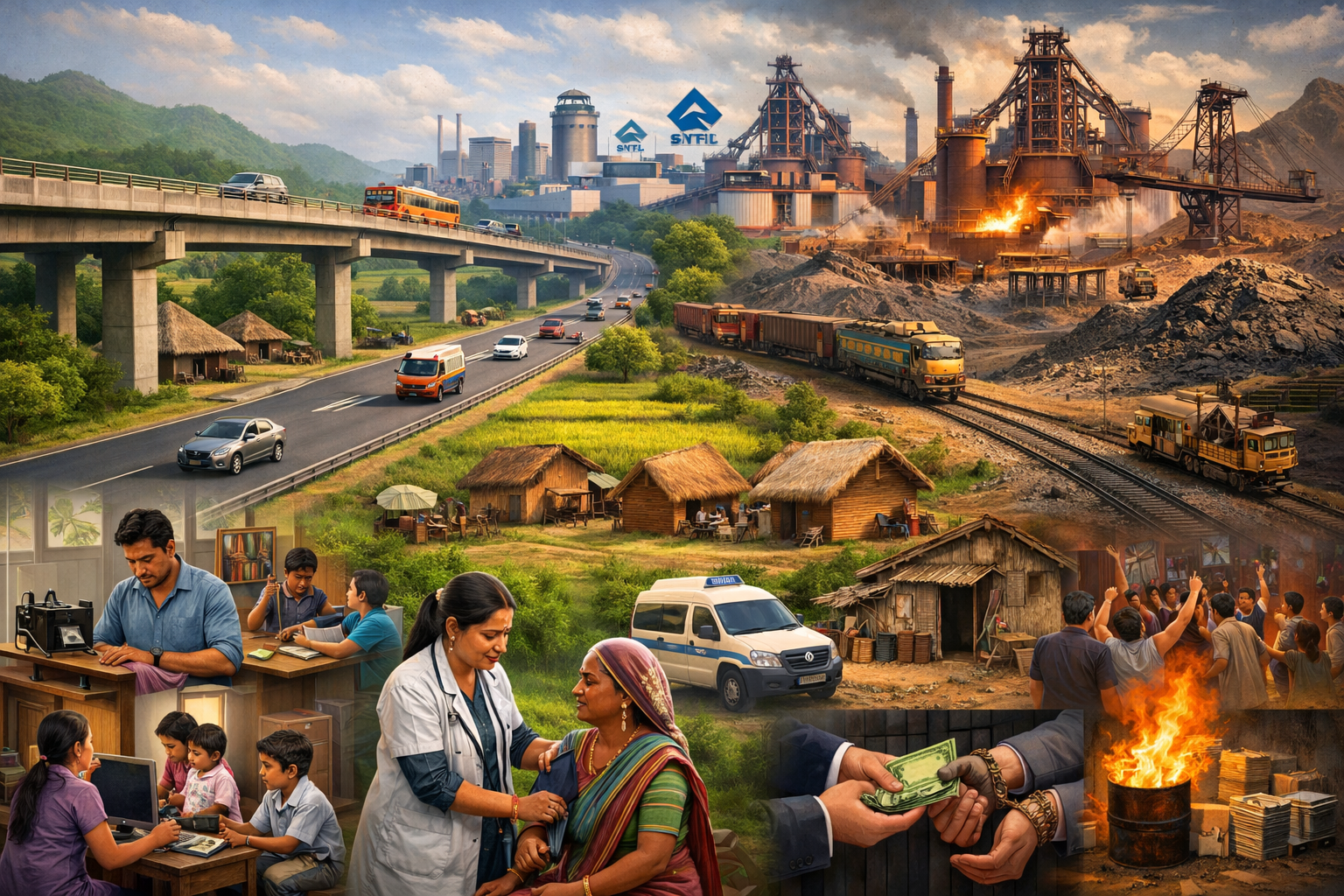
An in-depth analysis of the future of Koylanchal. Discover how government investments in education, healthcare, roads, railways, industry and jobs could transform Dhanbad, Bokaro, Giridih, Ramgarh and Hazaribagh by 2030.
A Region That Powered India. Can It Now Power Its Own Future?
For generations, Koylanchal has supplied the fuel that powered India’s growth.
The coal mines of Dhanbad, the steel ecosystem of Bokaro, the industrial belts of Ramgarh, and the emerging urban centres of Hazaribagh and Giridih have collectively contributed thousands of crores to the national economy.
Yet, despite producing immense wealth, many citizens still struggle with issues such as unemployment, inadequate infrastructure, migration of skilled youth, healthcare gaps, and uneven educational opportunities.
Today, however, something different is taking shape.
The Jharkhand Government’s ₹1.58 lakh crore Budget for 2026-27 and its broader Vision 2050 framework indicate a shift from a resource-based economy toward a development-driven economy focused on education, healthcare, infrastructure, technology, and human capital.
The question is no longer whether Koylanchal will develop.
The real question is:
Will this be the decade when Koylanchal finally receives the infrastructure, institutions and opportunities its people have waited for?
Education: The Foundation of Koylanchal’s Future
If there is one sector capable of changing the destiny of an entire region, it is education.
For years, students from Dhanbad, Bokaro, Giridih, Ramgarh and Hazaribagh have moved to Ranchi, Bengaluru, Delhi, Pune and Hyderabad in search of better educational opportunities.
The government now appears determined to reverse that trend.
₹16,251 Crore Allocated for School Education
The School Education and Literacy Department has been allocated approximately ₹16,251 crore in the 2026-27 Budget, making it one of the largest departmental allocations in the state. Combined with higher and technical education spending, education investment exceeds ₹18,800 crore.
This is significant because governments typically reveal their priorities through budgets.
A ₹16,000+ crore allocation sends a clear message:
Education is no longer being treated as a welfare activity. It is being treated as an economic growth strategy.
100 New CM Schools of Excellence
One of the biggest announcements is the establishment of 100 new Chief Minister Schools of Excellence.
These schools are expected to follow CBSE standards and provide modern educational infrastructure, smart classrooms, better laboratories, sports facilities and enhanced academic support. More than 80 such schools are already operational in the state.
Why This Matters
Many families currently spend large amounts of money on private education because they believe government schools cannot provide comparable quality.
The government’s objective is to create public schools that can compete with private institutions.
If implemented effectively, these schools could:
- Reduce educational inequality
- Improve board examination results
- Increase college admissions
- Lower education costs for families
- Strengthen competitive exam preparation
Girls’ Education Gets Special Attention
The budget also proposes five new girls’ residential schools, including two in Dhanbad district.
This may appear to be a small announcement, but its impact could be enormous.
In many rural and mining areas, girls discontinue education due to distance, safety concerns, or lack of facilities.
Residential schools directly address these challenges by providing:
- Safe accommodation
- Better academic support
- Reduced dropout rates
- Greater access to higher education
Technical Education: Preparing Youth for New Jobs
The government has also announced upgrades to polytechnic institutions under the J-Pragati initiative, including collaboration with premier institutions such as IITs and NITs. Government polytechnics are proposed to be upgraded into Jharkhand Institutes of Technology.
This is important because the future workforce will require skills beyond traditional mining.
Industries increasingly need:
- Cybersecurity professionals
- Data analysts
- AI specialists
- Manufacturing technicians
- Automation experts
- Renewable energy professionals
The students entering classrooms today will be the workforce driving Koylanchal in 2035 and beyond.
Healthcare: A Region That Shouldn’t Have to Travel for Treatment
Ask residents across Koylanchal where they go for advanced treatment.
Many will answer:
- Ranchi
- Kolkata
- Vellore
- Delhi
This reflects one of the region’s biggest challenges.
Healthcare access remains uneven despite the economic importance of the region.
Four New Medical Colleges
The state has proposed new medical colleges, including one in Dhanbad, under a public-private partnership model. The total estimated investment is over ₹1,200 crore.
What This Could Change
A medical college is not merely an educational institution.
It creates an ecosystem.
A medical college typically leads to:
- Better hospitals
- Specialist doctors
- Diagnostic centres
- Nursing colleges
- Research facilities
- Healthcare employment
For citizens, this means fewer referrals to distant cities and faster access to quality care.
Roads: The Invisible Engine of Development
When investors evaluate a region, one of the first questions they ask is:
How quickly can goods and people move?
Roads determine that answer.
The government’s infrastructure strategy includes investments in roads, bridges and rural connectivity. Roads and bridges account for a notable share of state expenditure, reflecting their importance to economic growth.
Why Better Roads Matter
A road does far more than connect two places.
It connects:
- Students to schools
- Patients to hospitals
- Farmers to markets
- Workers to jobs
- Businesses to customers
Every kilometre of improved road infrastructure increases economic activity.
Railways: The Lifeline of Koylanchal
No region understands railways better than Koylanchal.
Coal, steel, raw materials and industrial products move largely through the railway network.
Ongoing investments in railway infrastructure, station modernization, electrification and freight efficiency are expected to strengthen Jharkhand’s industrial competitiveness.
The Economic Impact
Efficient railways mean:
- Lower transportation costs
- Faster freight movement
- Increased industrial investment
- More logistics jobs
For a mining and industrial region, railways are not just transportation infrastructure—they are economic infrastructure.
Industry: Moving Beyond Coal
Coal will remain important.
However, no successful economy relies entirely on a single industry.
The next phase of growth must include:
- Manufacturing
- Technology services
- Startups
- Logistics
- Education services
- Healthcare services
This diversification is critical because future job growth will increasingly come from sectors outside traditional mining.
Youth: Koylanchal’s Greatest Untapped Resource
Every year, thousands of talented young people leave the region.
Not because they want to.
Because opportunities leave before they do.
Imagine a Koylanchal where:
- Students can study locally
- Graduates can find quality jobs
- Entrepreneurs can access funding
- Startups can grow
- Industries can recruit skilled workers
That is the real vision behind development.
Buildings and roads matter.
But human potential matters more.
The Challenge: Announcements vs Implementation
History teaches an important lesson.
Projects are easy to announce.
Projects are difficult to complete.
Citizens deserve answers to important questions:
- What is the project budget?
- Has the money been released?
- What is the current status?
- Why is there a delay?
- Who is responsible?
Development should not be measured by foundation stones.
It should be measured by outcomes.
Interesting Read
Why Koylanchal Is Launching a Development Tracker
Most media outlets report projects when they are announced.
Few track them afterward.
That is why Koylanchal will monitor:
| Sector | What We Will Track |
|---|---|
| Education | Schools, colleges, admissions, scholarships |
| Healthcare | Hospitals, medical colleges, services |
| Roads | Budgets, contractors, progress |
| Railways | Status, delays, timelines |
| Industry | Investments and jobs created |
| Government Schemes | Ground-level implementation |
| Employment | Public and private opportunities |
Our objective is simple:
Data over rumours. Facts over politics. Accountability over publicity.
The Road to 2030
The future of Koylanchal will not be decided by coal production alone.
It will be decided by:
- How many students graduate with employable skills.
- How many patients receive quality healthcare locally.
- How many jobs are created.
- How many projects are completed on time.
- How many citizens participate in shaping their communities.
Koylanchal has powered India for decades.
The next decade is an opportunity to power its own future.
And if the announced investments in education, healthcare, infrastructure and human capital are implemented effectively, Dhanbad, Bokaro, Giridih, Ramgarh and Hazaribagh could emerge as one of Eastern India’s most dynamic growth regions by 2030.
- Tags:
- #Bokaro
- #CareerGrowth
- #CareerOpportunities
- #DataDrivenNews
- #DevelopmentProjects
- #DevelopmentTracker
- #Dhanbad
- #DhanbadDevelopment
- #DhanbadNews
- #EducationNews
- #Giridih
- #GovernmentJobs
- #Healthcare
- #HealthInfrastructure
- #IndiaDevelopment
- #InfrastructureDevelopment
- #JharkhandNews
- #Jobs
- #Koylanchal
- #Koylanchal Development
- #Koylanchal2030
- #MSME
- #PeopleFirst
- #PublicHealth
- #RailwayDevelopment
- #RegionalNews
- #StartupIndia
- #YouthDevelopment
