
By Koylanchal Tourism Desk
Hidden among the forests and sandstone hills of Hazaribagh district lies one of India’s most fascinating yet least-known archaeological treasures. While the world celebrates the prehistoric cave paintings of Bhimbetka in Madhya Pradesh, few people know that Jharkhand is home to an equally remarkable prehistoric art gallery—the Isko Rock Shelter.
Located near Isko village in Napo Panchayat, around 32 kilometers west of Hazaribagh, this ancient rock shelter preserves mysterious paintings, geometric symbols, animal figures, and prehistoric artwork believed to date back thousands of years. Historians and archaeologists regard Isko as one of the most important rock art sites in eastern India because it offers a rare glimpse into the lives, beliefs, and artistic skills of early human communities.
What makes Isko even more intriguing is that many of its symbols remain undeciphered to this day. The rock walls feature abstract geometric designs unlike most prehistoric sites, leaving researchers puzzled about their true meaning. For travelers interested in archaeology, ancient civilizations, tribal culture, and hidden destinations, Isko is one of Jharkhand’s greatest undiscovered wonders.
Where is Isko Rock Shelter Located?
The Isko Rock Shelter is situated near Isko village in Napo Panchayat under Barkagaon Block of Hazaribagh district, Jharkhand.
It lies approximately:
- 32 km from Hazaribagh town
- 15 km from Barkagaon
- 90 km from Ranchi
- Easily accessible by road from both Ranchi and Hazaribagh
The shelter stands at the edge of dense forests where the village landscape gradually transitions into the wilderness. Nearby flows the peaceful Dudhi Nala, a seasonal stream that likely provided water to prehistoric communities thousands of years ago.
Even today, visitors are welcomed by a serene natural environment, making the site ideal for heritage tourism and nature exploration.
Discovery of the Hidden Treasure
Although local villagers had known about the painted shelter for generations, the archaeological importance of Isko gained recognition only during the 1990s.
The site was first documented by Jesuit priest Father Tony Herbert, whose exploration brought the rock paintings to wider academic attention. Later, local historians and archaeologists conducted detailed studies that revealed the extraordinary significance of the shelter.
Since then, Isko has emerged as one of the finest examples of prehistoric rock art in eastern India, attracting researchers, archaeologists, and history enthusiasts from across the country.
A Natural Gallery Created Thousands of Years Ago
Unlike modern museums, Isko’s gallery was created entirely by nature.
The shelter is a massive sandstone overhang standing approximately 20 feet high. The painted section stretches around 30.5 meters in length and nearly 2.25 meters in height, making it one of the largest painted rock surfaces in the region.
The shelter itself is divided into four interconnected chambers, each containing different forms of prehistoric artwork.
Despite centuries of exposure to changing weather conditions, many paintings remain remarkably visible, demonstrating the durability of natural pigments used by ancient artists.
Paintings That Continue to Puzzle Archaeologists
The greatest attraction of Isko lies in its remarkable collection of prehistoric paintings.
Unlike many other rock art sites that primarily depict hunting scenes, Isko features an unusual combination of animals, geometric figures, abstract symbols, human forms, and mysterious pictographs.
Among the most prominent depictions are:
- Bison
- Buffalo
- Deer
- Wild cattle
- Rhinoceros
- Frogs
- Turtles
- Human figures
- Circular symbols
- Concentric designs
- Sun motifs
- Cryptic inscriptions
- Geometric patterns
Many of these symbols remain undeciphered.
Archaeologists continue to debate whether they represent:
- Religious rituals
- Clan symbols
- Early communication systems
- Astronomical observations
- Fertility rituals
- Territorial markings
Their true meaning remains one of the greatest mysteries surrounding Isko.
The Fascinating Story of the Rhinoceros
One of the most remarkable discoveries is the painting of a rhinoceros.
Today, rhinoceroses no longer inhabit the forests of Jharkhand. Historical evidence suggests they disappeared from this region nearly 200 years ago.
The existence of rhinoceros paintings indicates that prehistoric artists documented animals that once freely roamed these forests, providing valuable evidence about the ancient ecology of eastern India.
For wildlife historians, these paintings serve as visual records of extinct regional biodiversity.
Colors That Have Survived Thousands of Years
The artists of Isko relied entirely on naturally available minerals to create their masterpieces.
Three primary colours dominate the paintings:
- Ochre (red)
- White
- Black
Researchers believe these pigments were prepared using:
- Iron oxide
- Limestone
- Charcoal
- Plant extracts
- Natural binders
he remarkable preservation of these colours demonstrates the sophisticated knowledge prehistoric communities possessed about natural materials.
Interesting Reads
Attractions of ASI Ranchi Circle – Isko, Barkagaon, Distt. Hazaribagh
Rajmahal Hills: The Forgotten Land Where Dinosaurs Once Walked in Jharkhand
How Ancient Artists Created the Paintings
Studies of the artwork reveal a surprisingly advanced painting technique.
Instead of directly filling colours, prehistoric artists first:
- Drew the outline of the figure.
- Carefully filled the interior using pigments.
- Added thicker outer lines for emphasis.
- Occasionally used multiple colours for decoration.
The varying brush strokes suggest the use of different tools, possibly including twigs, animal hair, feathers, or fingers.
This artistic sophistication indicates that painting was not merely decorative but likely held cultural or spiritual significance.
Dating the Isko Rock Shelter
Dating prehistoric art is always challenging, but archaeological evidence provides important clues.
Most experts associate the Isko Rock Shelter with the Meso-Chalcolithic period, when early communities had begun using both stone and copper tools.
Some scholars, however, argue that portions of the site could date back even earlier to the Middle Paleolithic period, making Isko one of the oldest cultural sites in eastern India.
Archaeological excavations around the shelter have uncovered numerous prehistoric tools, including:
- Hand axes
- Choppers
- Chopping tools
- Microliths
- Blades
- Scrapers
- Stone points
These discoveries confirm that Isko served not only as an artistic center but also as a settlement area for prehistoric communities.
The Meaning Behind “Kohbar”
The local tribal communities refer to the shelter as Kohbar.
This name comes from traditional wedding customs practiced in Jharkhand and neighboring Bihar.
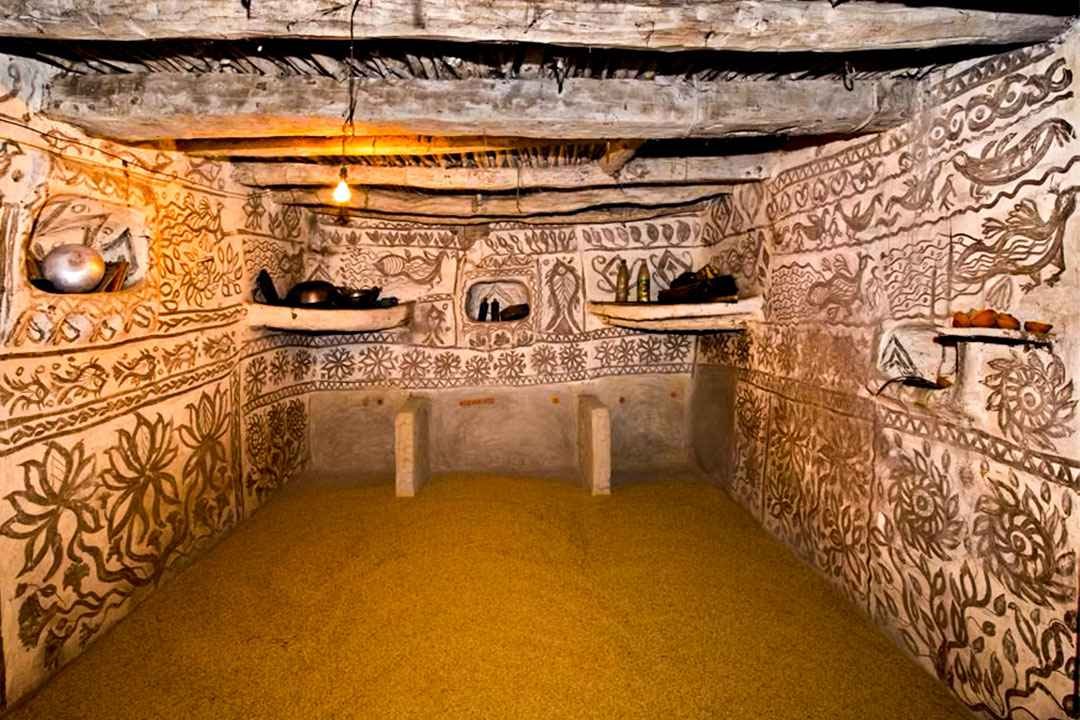
In many rural households, the walls of the bridal chamber—known as the Kohbar room—are decorated with symbolic paintings representing fertility, prosperity, nature, and family life.
The geometric motifs painted inside Isko bear striking similarities to these traditional folk paintings.
Many researchers believe that this artistic tradition may have survived across generations for thousands of years, connecting modern tribal culture with prehistoric artistic heritage.
Living Heritage Among Tribal Communities
One of Isko’s most fascinating aspects is that its artistic traditions continue to influence local communities.
Villagers living nearby still decorate their mud houses with traditional wall paintings featuring:
- Floral motifs
- Geometric designs
- Animal figures
- Ritual symbols
Although these contemporary artworks differ in style, many scholars believe they preserve echoes of the ancient visual language seen inside the rock shelter.
This continuity makes Isko not merely an archaeological monument but a living cultural landscape.
What the Paintings Reveal About Ancient Life
The Isko paintings provide valuable insights into prehistoric society.
Researchers believe they reveal information about:
Wildlife
The paintings confirm that the forests once supported rich biodiversity, including species no longer found in the region.
Hunting
Animal depictions suggest hunting played an important role in survival.
Spiritual Beliefs
Abstract symbols may represent rituals, mythology, or religious practices.
Social Organization
Human figures indicate organized communities rather than isolated individuals.
Artistic Development
The complexity of the paintings demonstrates remarkable creative ability among prehistoric humans.
Conservation and Archaeological Importance
Over the years, weathering and human activity have threatened the preservation of the paintings.
Recognizing the site’s significance, archaeological authorities have undertaken documentation and conservation initiatives.
Experts recommend:
- Controlled tourism
- Better visitor awareness
- Scientific preservation
- Protection from vandalism
- Improved interpretation facilities
Conservation remains essential because once prehistoric paintings disappear, they cannot be recreated.
Visiting Isko Today
Although still relatively unknown, Isko offers a rewarding experience for history lovers.
Visitors can explore:
- The prehistoric painted shelter
- Forest landscapes
- Tribal villages
- Dudhi Nala stream
- Rural heritage
- Nearby archaeological locations
Unlike crowded heritage monuments, Isko allows visitors to experience history in a peaceful natural environment.
Best Time to Visit
The ideal months are:
- October
- November
- December
- January
- February
The post-monsoon greenery enhances the beauty of the surrounding forests while making travel more comfortable.
Nearby Attractions
Visitors can combine Isko with several nearby destinations:
- Hazaribagh Wildlife Sanctuary
- Canary Hill
- Konar Dam
- Barkagaon region
- Local tribal villages
- Ranchi tourist circuit
This makes Isko a valuable addition to Jharkhand’s growing heritage tourism network.
Why Isko Deserves National Recognition
Despite its extraordinary archaeological value, Isko remains largely absent from mainstream tourism.
The site deserves wider recognition because it:
- Preserves rare prehistoric paintings.
- Contains mysterious undeciphered symbols.
- Connects ancient art with living tribal traditions.
- Reveals the ecological history of Jharkhand.
- Represents one of eastern India’s most important archaeological sites.
With improved conservation, responsible tourism, and greater public awareness, Isko has the potential to become one of India’s leading heritage destinations.
Conclusion
The Isko Rock Shelter is far more than a collection of ancient paintings. It is a priceless archive of prehistoric human creativity, preserving stories that have survived for thousands of years on sandstone walls deep inside Jharkhand’s forests.
Every animal figure, geometric pattern, and mysterious symbol reflects the thoughts and beliefs of people who lived long before written history began. While many of their messages remain undeciphered, they continue to inspire archaeologists, historians, artists, and travelers alike.
As India increasingly embraces its lesser-known heritage destinations, Isko deserves a prominent place on every history enthusiast’s travel list. It reminds us that some of humanity’s oldest masterpieces are not housed in museums—they remain exactly where they were created, waiting patiently to be discovered.
For anyone seeking an authentic journey into India’s prehistoric past, Isko is not simply a tourist destination—it is a timeless window into the origins of art, culture, and civilization.
