
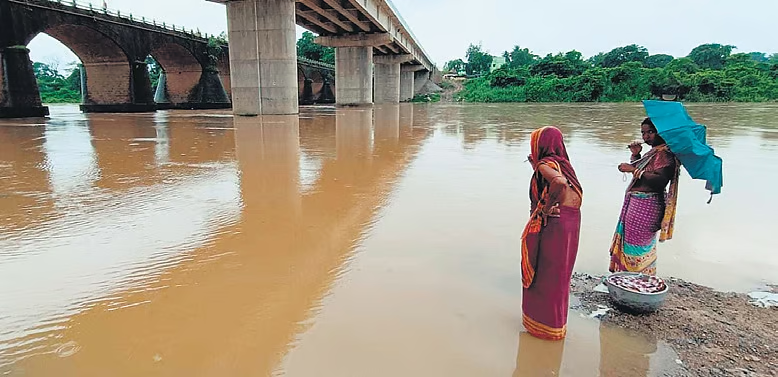
For nearly a quarter of a century, the sharing of the Sone River’s waters between Bihar and Jharkhand remained one of eastern India’s most significant unresolved interstate water disputes. Since Jharkhand was carved out of Bihar in November 2000, both states have operated without a formal agreement on dividing Bihar’s original share of the Sone River under the historic Bansagar Agreement.
That chapter now appears to be coming to an end.
The Union Ministry of Jal Shakti has confirmed that Bihar and Jharkhand are preparing to sign a long-awaited Memorandum of Understanding (MoU) that will formally allocate Sone River water between the two states. According to officials, all major approvals have been completed, and the agreement could be signed soon in the presence of Union Jal Shakti Minister and the Chief Ministers of Bihar and Jharkhand.
The development marks a major milestone in India’s interstate water governance and is expected to provide clarity for irrigation, drinking water, industrial development, and future water management projects across both states.
A Dispute That Lasted Nearly 25 Years
The origins of the dispute date back to November 15, 2000, when Jharkhand was carved out of the erstwhile state of Bihar.
While administrative boundaries changed overnight, the division of river water resources remained unresolved.
The Sone River, one of the most important tributaries of the Ganga, flows through several states and supports millions of people through agriculture, irrigation, industries, and domestic water supply.
Before Jharkhand’s creation, Bihar received a fixed allocation of Sone River water under the 1973 Bansagar Agreement, signed among:
- Bihar (then undivided)
- Madhya Pradesh
- Uttar Pradesh
However, after state bifurcation, Bihar’s allocated share had to be divided between Bihar and the newly formed Jharkhand.
That never officially happened.
Instead, the issue remained pending for nearly twenty-five years.
Understanding the 1973 Bansagar Agreement
The Bansagar Agreement remains one of India’s most significant interstate river-sharing arrangements.
Signed in 1973, it governs the sharing of Sone River waters among participating states.
Under the original agreement, undivided Bihar received:
7.75 Million Acre-Feet (MAF) of water annually.
When Jharkhand became a separate state, questions immediately arose:
- How much water should Bihar retain?
- What portion should Jharkhand receive?
- Who would oversee future allocation?
- How should irrigation infrastructure be managed?
Without a formal settlement, these questions continued to affect long-term planning.
Centre Steps In
Recognising the prolonged nature of the dispute, the Union Government constituted a committee under the chairmanship of the Central Water Commission (CWC).
The committee included representatives from:
- Government of Bihar
- Government of Jharkhand
- Ministry of Jal Shakti
- Central Water Commission
Its objective was straightforward:
Find an acceptable formula for dividing Bihar’s original allocation.
After extensive consultations, technical assessments, and discussions with both states, the committee arrived at a unanimous recommendation.
The New Water Sharing Formula
According to the proposed agreement:
Bihar will receive:
5.75 Million Acre-Feet (MAF)
Jharkhand will receive:
2.00 Million Acre-Feet (MAF)
Together, these allocations account for Bihar’s original entitlement of 7.75 MAF under the Bansagar Agreement.
Officials say both states have accepted this recommendation.
Jharkhand’s Cabinet reportedly approved the proposal earlier this month, while Bihar has also completed the necessary internal procedures.
Agreement Ready for Signing
Officials from the Ministry of Jal Shakti indicate that the only remaining step is scheduling the signing ceremony.
According to ministry communications:
- Both states have conveyed formal consent.
- Draft documents have been finalized.
- Administrative paperwork is complete.
- Signing is expected in August once schedules are coordinated.
The ceremony is expected to include:
- Union Jal Shakti Minister
- Chief Minister of Bihar
- Chief Minister of Jharkhand
- Senior officials from both state governments
The MoU will formally conclude one of the oldest pending administrative issues arising from Bihar’s bifurcation.
Why the Sone River Matters
The Sone River is among the largest southern tributaries of the Ganga River.
Originating near Amarkantak in Madhya Pradesh, it flows through:
- Madhya Pradesh
- Uttar Pradesh
- Chhattisgarh (catchment influence)
- Jharkhand
- Bihar
Before joining the Ganga near Patna.
The river supports:
- Large irrigation networks
- Drinking water systems
- Agricultural production
- Industrial water supply
- Hydrological balance
- Fisheries
- Groundwater recharge
For both Bihar and Jharkhand, its importance extends far beyond water availability.
It is central to regional development.
What This Means for Bihar
For Bihar, the agreement brings long-awaited certainty over water availability.
The state depends heavily on irrigation to support its agriculture-driven economy.
Reliable water allocation helps in:
- Better crop planning
- Canal management
- Irrigation expansion
- Infrastructure investment
- Water conservation planning
Government departments can now undertake long-term projects without uncertainty regarding future allocations.
Interesting Read
Bihar, Jharkhand set to sign MoU for sharing Sone river waters
Can Technology Drive the State’s Economic Transformation?
What It Means for Jharkhand
Jharkhand also stands to gain significantly.
The state’s 2.0 MAF allocation provides an officially recognised entitlement for future planning.
The agreement could support:
- Irrigation projects
- Rural drinking water schemes
- Industrial corridors
- Mining regions requiring sustainable water use
- Urban development
For Jharkhand, formal recognition of its share strengthens future planning and reduces administrative ambiguity.
How the Sone River Shapes the Economy of Bihar and Jharkhand
The Sone River has long been one of eastern India’s most important rivers for agriculture, irrigation, and rural livelihoods. Originating near Amarkantak in Madhya Pradesh, it flows through Chhattisgarh, Uttar Pradesh, Jharkhand, and Bihar before joining the Ganga near Patna.
For millions of farmers, the river serves as a lifeline, supporting irrigation for crops such as paddy, wheat, maize, pulses, and vegetables. Several irrigation canals and water distribution systems connected to the Sone River have transformed otherwise drought-prone regions into productive agricultural zones.
Apart from farming, the river also supports fisheries, groundwater recharge, livestock, and drinking water supplies for numerous villages and towns. Industrial development in parts of Bihar and Jharkhand also depends on sustainable access to river water, making equitable sharing an economic necessity.
Importance for Farmers
Agriculture remains the largest beneficiary of interstate river agreements.
Water certainty enables governments to:
- Expand irrigation networks.
- Improve crop productivity.
- Reduce dependence on monsoon rainfall.
- Promote diversified agriculture.
- Enhance food security.
Farmers in both states are expected to benefit from better long-term planning once water allocations become formally institutionalised.
Impact on Infrastructure Development
Large infrastructure projects often require legally recognised water availability before receiving approvals.
With the agreement in place, future investments may become easier in areas such as:
- Irrigation canals
- Reservoir upgrades
- Drinking water systems
- Industrial parks
- Smart city development
- Rural water supply schemes
Investors generally prefer policy certainty before committing resources.
Importance for Interstate Relations
India has witnessed several prolonged interstate river disputes over the decades.
Examples include:
- Cauvery
- Krishna
- Ravi-Beas
- Mahanadi
Many of these disputes have resulted in years of litigation.
The Bihar-Jharkhand settlement demonstrates that negotiated agreements supported by technical committees can provide peaceful solutions.
It also reflects improved cooperation between the two neighbouring states.
Government’s Role
Officials credit the Ministry of Jal Shakti for facilitating discussions.
The ministry reportedly:
- Coordinated technical assessments.
- Consulted both state governments.
- Prepared draft agreements.
- Facilitated administrative approvals.
- Scheduled final execution.
The Central Water Commission also played a key technical role by evaluating historical allocations and recommending an equitable division.
What Happens After Signing?
Once the MoU is signed:
- Water allocation becomes formally recognised.
- Administrative implementation begins.
- Departments can integrate allocations into planning.
- Future disputes regarding Bihar’s historical share are expected to reduce substantially.
Implementation will likely involve periodic coordination between both states and the Centre to ensure compliance with the agreed formula.
Mahanadi Dispute Next on Centre’s Agenda
With the Sone River issue nearing resolution, Union officials have indicated that attention may now shift toward another major interstate river conflict—the Mahanadi dispute.
The dispute between Odisha and Chhattisgarh has remained unresolved for years and concerns:
- Water sharing.
- Upstream projects.
- Reservoir construction.
- Irrigation impacts.
- Environmental flow.
Officials have indicated that both states have approached the Centre seeking assistance in finding a solution, although no timeline has yet been announced.
Why Water-Sharing Agreements Matter More Than Ever
Climate change, irregular rainfall, and increasing demand for water have made interstate cooperation more important than ever.
India’s rivers are shared natural resources, and sustainable management requires collaboration rather than conflict.
Formal agreements help:
- Reduce legal disputes.
- Encourage scientific water management.
- Improve disaster preparedness.
- Strengthen drought resilience.
- Promote equitable resource distribution.
The Bihar-Jharkhand agreement may serve as a model for resolving similar disputes across the country.
Challenges Ahead
Although the agreement resolves the allocation issue, effective implementation will require continued coordination.
Future priorities may include:
- Efficient water use.
- Canal modernisation.
- Rainwater harvesting.
- Groundwater recharge.
- Climate-resilient irrigation practices.
- Joint monitoring mechanisms.
Experts also emphasise the need for integrated river basin management to ensure that growing water demand does not create fresh disputes.
A Landmark Step for Cooperative Federalism
The impending Sone River water-sharing agreement represents more than just an administrative settlement. It reflects the ability of states and the Union Government to resolve long-pending issues through dialogue, technical expertise, and consensus.
After nearly twenty-five years of uncertainty following Jharkhand’s formation, both states now have a clear framework for sharing one of eastern India’s most important river resources.
For farmers, industries, planners, and millions of residents dependent on the Sone River, the agreement promises greater certainty and improved long-term water management. While implementation will remain crucial, the MoU marks a significant step toward strengthening cooperative federalism and sustainable water governance in India.
As the signing ceremony approaches, the agreement is expected to become one of the most important interstate water settlements in recent years, potentially setting an example for resolving other river-sharing disputes through cooperation rather than confrontation.
