
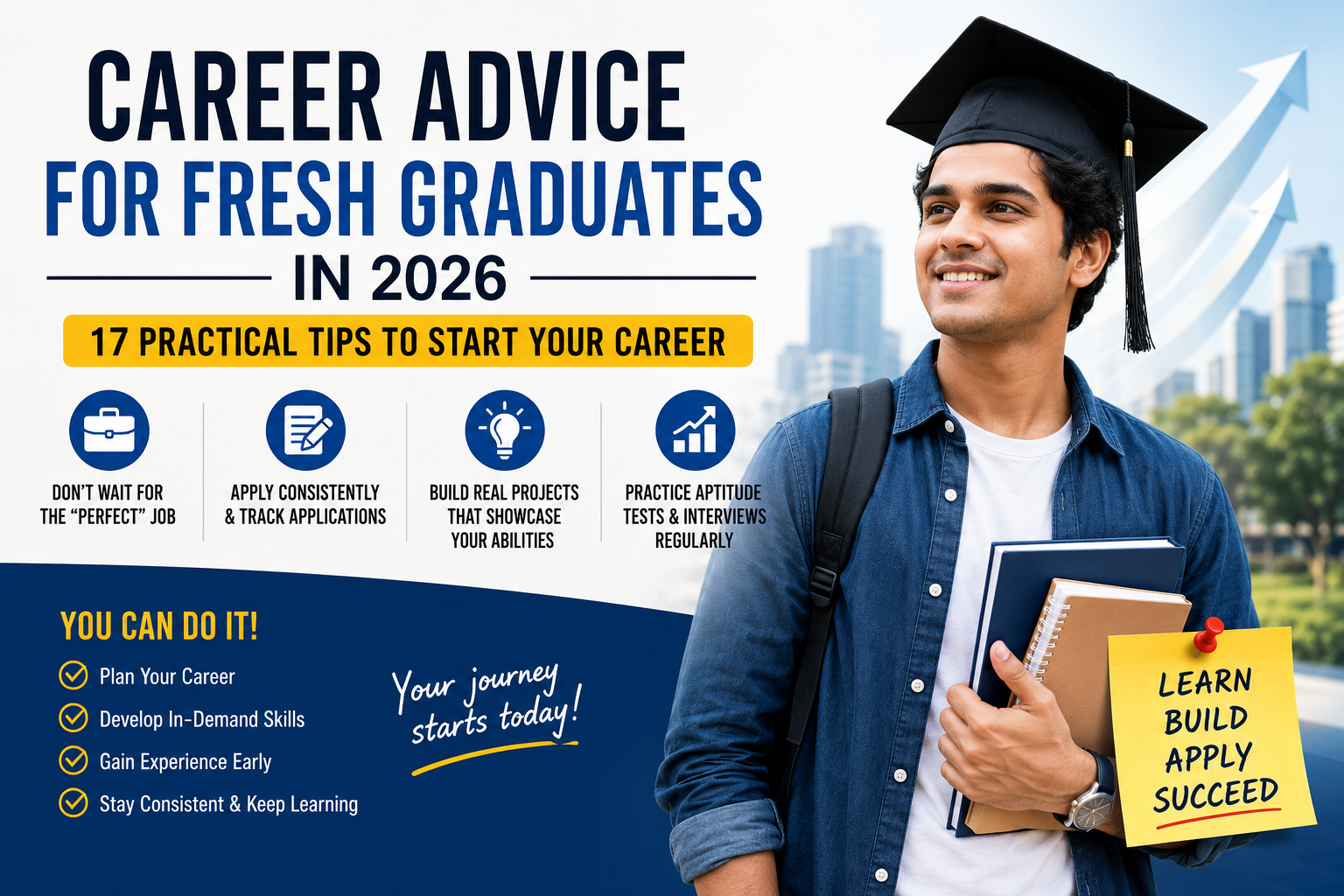
Career Advice for Fresh Graduates in 2026: 17 Job Tips
Graduating from college is often seen as the beginning of professional life. Yet for many fresh graduates, the transition from classroom learning to the job market can be confusing and challenging. Students spend years earning degrees, completing assignments, attending examinations, and preparing for graduation, only to discover that finding the first job requires a completely different set of skills.
In 2026, this transition is becoming even more competitive. Technology is changing rapidly, employers are increasingly looking for practical skills, and Artificial Intelligence is transforming how organizations recruit, evaluate, and train employees.
For fresh graduates, this does not mean opportunities are disappearing. Instead, it means candidates need to approach their job search strategically.
The most important advice is simple: don’t wait for the perfect job to begin your career. Start building experience, skills, projects, and professional connections as early as possible.
Whether you are an engineering graduate, commerce graduate, arts graduate, management student, or someone entering the workforce after professional training, the following strategies can help you build a stronger career foundation.
1. Don’t Wait for the “Perfect” Job
One of the biggest mistakes fresh graduates make is waiting for the ideal opportunity before beginning their professional journey.
You may have a specific company, salary, designation, location, or job profile in mind. Having goals is useful, but being too rigid can delay your career development.
Your first job does not have to be your final career.
The first role should ideally help you gain:
- Practical experience
- Industry exposure
- Professional communication skills
- Technical knowledge
- Teamwork experience
- Understanding of workplace expectations
- A professional network
- Achievements that can strengthen your résumé
For example, a graduate interested in digital marketing might not immediately receive a position at a major company. Starting with a small agency, internship, freelance project, or startup can still provide valuable experience.
Similarly, an engineering graduate may begin with a junior technical position before eventually moving into a specialized role.
The objective is to start moving forward rather than waiting indefinitely for the perfect opportunity.
Experience Can Create Better Opportunities
Recruiters often want candidates who can demonstrate that they understand how workplaces function.
Even six months of relevant experience can give a graduate examples to discuss during interviews.
Instead of saying:
“I have studied digital marketing.”
you may be able to say:
“I worked on an SEO project where I optimized website pages, researched keywords, tracked rankings, and analyzed traffic.”
The second statement demonstrates application of knowledge.
That difference can be extremely valuable during recruitment.
2. Consider Internships and Entry-Level Roles
If you’re struggling to find a full-time job, don’t ignore internships.
Internships can help graduates bridge the gap between education and employment.
Look for internships that provide opportunities to:
- Work on real projects
- Interact with clients
- Use professional software
- Collaborate with teams
- Solve workplace problems
- Learn industry processes
- Receive feedback from experienced professionals
However, don’t accept an internship solely because it gives you a certificate.
Ask yourself:
“What will I actually learn or build during this experience?”
A strong internship can provide portfolio material, references, practical skills, and potentially a pathway to a full-time position.
Freelancing and project-based work can also help candidates gain experience when traditional employment is difficult to secure.
3. Apply Consistently Instead of Applying Randomly
Job searching can become frustrating when applications produce no immediate results.
One solution is to create a structured application strategy.
Instead of applying to dozens of jobs randomly, establish a weekly target.
For example:
Monday–Friday
- Search for relevant openings
- Apply to suitable positions
- Customize your résumé
- Research companies
- Connect with recruiters
- Follow up on previous applications
The objective isn’t simply to send hundreds of applications.
The goal is to send high-quality, relevant applications consistently.
4. Track Every Job Application
One of the simplest ways to improve your job search is to maintain an application tracker.
You can create a basic spreadsheet containing:
| Company | Job Role | Date Applied | Source | Status | Follow-Up Date |
|---|---|---|---|---|---|
| Company A | Junior Developer | Aug 2 | Applied | Aug 9 | |
| Company B | Data Analyst | Aug 3 | Company Website | Interview | Aug 7 |
| Company C | Marketing Executive | Aug 4 | Job Portal | Rejected | — |
This prevents applications from becoming disorganized.
It also helps you identify patterns.
For example, if you’re applying to 50 positions and receiving no interview invitations, your résumé or targeting strategy may need improvement.
If you’re receiving interviews but not offers, interview preparation may be the issue.
Your job search should therefore be treated as a process that you can measure and improve.
5. Customize Your Résumé for Different Jobs
Sending the same résumé to every company is another common mistake.
Different jobs require different skills.
Suppose you’re applying for a Data Analyst position.
Your résumé should emphasize:
- Excel
- SQL
- Power BI
- Python
- Data visualization
- Analytical projects
If you’re applying for a web development position, highlight:
- HTML
- CSS
- JavaScript
- WordPress
- PHP
- Git
- Website projects
The goal is to make it immediately clear why you’re relevant to the position.
Avoid filling your résumé with every skill you’ve ever encountered.
Focus on skills that match the role.
Interesting Reads
Career guidance for freshers in India: Expert tips for success (2026)
Focus on High-Growth Industries: Top Career Sectors to Watch in 2026 and Beyond
6. Build Real Projects That Demonstrate Your Abilities
A degree tells an employer what you studied.
A project can demonstrate what you can actually do.
This is why fresh graduates should build practical projects before or while searching for employment.
Projects don’t necessarily need to be complicated.
For example:
Engineering Students
- IoT monitoring system
- Embedded systems project
- Smart home prototype
- Sensor-based automation
- Robotics project
Computer Science Students
- Web application
- Mobile application
- AI chatbot
- Data analysis dashboard
- Cybersecurity laboratory project
Commerce Students
- Financial analysis
- Business dashboard
- Market research report
- Excel-based financial model
Marketing Students
- SEO campaign
- Social media strategy
- Content marketing project
- Website analytics report
The important thing is to document what you did.
Explain:
Problem → Approach → Tools → Your Contribution → Result
That turns a basic project into a strong interview discussion.
7. Build a Portfolio
If you have completed multiple projects, create a professional portfolio.
Depending on your field, this could include:
- GitHub profile
- Personal website
- Design portfolio
- Writing samples
- Case studies
- Project documentation
- Data dashboards
- Research papers
Your portfolio gives recruiters an opportunity to see evidence of your capabilities.
For fresh graduates, this can be particularly valuable because they may not yet have extensive employment history.
8. Learn Skills That Employers Actually Need
A degree alone may not be enough in a rapidly changing job market.
Fresh graduates should continuously develop practical skills relevant to their target roles.
Depending on your career path, these might include:
- Artificial Intelligence
- Data Analytics
- Cybersecurity
- Cloud Computing
- Digital Marketing
- Programming
- Communication
- Project Management
- Business Analytics
- Financial Technology
The World Economic Forum’s Future of Jobs research highlights technological skills such as AI and big data, networks and cybersecurity, and technological literacy among rapidly growing skill areas. It also emphasizes human skills such as analytical thinking, creative thinking, resilience, leadership, and collaboration.
This means graduates should avoid focusing exclusively on technical skills.
A candidate who can combine technical ability with communication and problem-solving may have a stronger professional profile.
9. Use AI as a Career Tool
Artificial Intelligence can be useful during your job search when used responsibly.
You can use AI tools to:
- Improve résumé wording
- Identify missing skills
- Practice interview questions
- Generate aptitude questions
- Research companies
- Summarize job descriptions
- Brainstorm project ideas
- Improve professional emails
- Practice communication
However, don’t allow AI to completely replace your own thinking.
For example, if an AI tool writes your entire résumé, make sure every statement is accurate.
If you use AI to prepare interview answers, understand the concepts rather than memorizing generated responses.
Employers want candidates who can think independently.
10. Practice Aptitude Tests Regularly
Many companies use aptitude assessments during recruitment, especially for entry-level roles.
Common areas include:
Quantitative Aptitude
- Percentages
- Ratios
- Profit and loss
- Time and work
- Time, speed and distance
- Probability
- Averages
- Number systems
Logical Reasoning
- Series
- Puzzles
- Coding-decoding
- Blood relations
- Directions
- Syllogisms
- Data interpretation
Verbal Ability
- Reading comprehension
- Grammar
- Vocabulary
- Sentence correction
- Para jumbles
Instead of preparing only when an assessment arrives, practice regularly.
Even 30–45 minutes a day can help you improve speed and accuracy.
11. Prepare for Interviews Before You Get the Call
Don’t wait until an interview is scheduled to begin preparing.
Start practicing early.
Prepare answers to questions such as:
- Tell me about yourself.
- Why should we hire you?
- Why do you want this role?
- What are your strengths?
- What is your biggest weakness?
- Tell me about a project you completed.
- Describe a challenge you faced.
- Why do you want to join our company?
- Where do you see yourself in five years?
You should also prepare questions to ask the interviewer.
For example:
“What would success look like in this role during the first six months?”
This demonstrates interest in the position and the organization’s expectations.
12. Learn to Explain Your Projects
Fresh graduates are frequently asked about academic or personal projects.
Don’t simply memorize technical definitions.
Be prepared to explain:
- What problem were you solving?
- Why did you choose the project?
- What technologies did you use?
- What was your individual contribution?
- What difficulties did you encounter?
- How did you solve them?
- What did you learn?
- What would you improve if you rebuilt it?
If you can confidently answer these questions, even a relatively small project can become an impressive interview discussion.
13. Improve Communication Skills
Technical knowledge can get you shortlisted, but communication can influence how effectively you perform in interviews and workplaces.
Work on:
- Speaking clearly
- Writing professional emails
- Giving presentations
- Listening carefully
- Explaining technical concepts simply
- Participating in discussions
You don’t need to use complicated English.
Clear communication is more important than complicated vocabulary.
Practice by explaining something you learned to another person.
If you can explain a complex subject simply, you are developing an important professional skill.
14. Build a Professional Online Presence
Recruiters may review a candidate’s online presence.
Make sure your professional profiles communicate what you want employers to know.
Your LinkedIn profile should include:
- Professional headline
- Education
- Skills
- Projects
- Certifications
- Internship experience
- Achievements
- Relevant interests
You can also share:
- Project updates
- Industry insights
- Learning experiences
- Certifications
- Career lessons
Your online presence can become an extension of your résumé.
15. Network With Professionals
Networking can open opportunities that aren’t always visible on job portals.
Connect with:
- Alumni
- Recruiters
- Industry professionals
- Former interns
- College faculty
- Startup founders
- Professionals working in your target companies
Don’t approach networking only by asking:
“Do you have a job for me?”
Instead, ask thoughtful questions.
For example:
“I’m a recent graduate interested in cybersecurity. What skills would you recommend I develop for an entry-level role in this field?”
Such conversations can lead to advice, referrals, mentorship, and opportunities.
16. Don’t Take Rejection Personally
Rejection is one of the hardest parts of entering the job market.
You may apply for 20 jobs and receive several rejections.
That doesn’t automatically mean you lack ability.
The position may have attracted hundreds of applicants.
Another candidate may have had more relevant experience.
The company may have changed its hiring requirements.
Instead of thinking:
“I’m not good enough.”
Ask:
“What can I improve before the next application?”
Use rejection as feedback.
Improve your résumé.
Build another project.
Practice interviews.
Develop a new skill.
Apply again.
17. Create a 90-Day Career Plan
Instead of approaching your job search without a clear direction, create a three-month plan.
Month 1: Build the Foundation
- Update résumé
- Improve LinkedIn profile
- Select target job roles
- Identify skill gaps
- Begin aptitude practice
Month 2: Build Evidence
- Complete one major project
- Build portfolio
- Start networking
- Complete relevant certification
- Begin regular job applications
Month 3: Increase Applications and Interview Preparation
- Apply consistently
- Practice mock interviews
- Improve weak areas
- Follow up with recruiters
- Expand professional network
This approach transforms job searching from a stressful activity into a structured career project.
Conclusion: Start Before You Feel Ready
The first stage of your career does not need to be perfect.
It needs to be productive.
Don’t wait for the perfect job before gaining experience. Apply consistently, track your applications, build projects, practice aptitude tests, prepare for interviews, and continue developing skills.
Most importantly, remember that your career is not determined by your first job.
Your first role is a starting point.
The experience you gain, the skills you develop, the projects you build, and the professional relationships you create can gradually lead you toward better opportunities.
For fresh graduates entering the 2026 job market, the winning approach is not simply “find a job.”
It is:
Learn → Build → Apply → Practice → Improve → Repeat.
The earlier you begin this cycle, the faster you can turn your degree into a meaningful professional career.
