
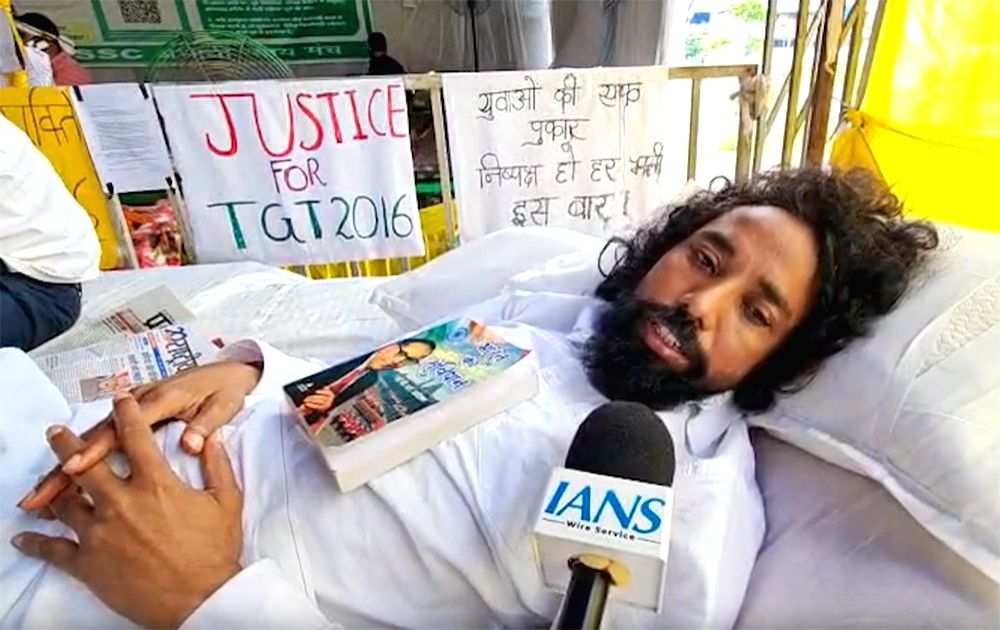
Ranchi: A growing student movement in Jharkhand has once again put recruitment examinations and transparency in the spotlight, with student leader Devendra Nath Mahto emerging as the public face of the ongoing protest in Ranchi.
Mahto has begun an indefinite hunger strike at Jaipal Singh Munda Stadium, where students have been protesting alleged irregularities in recruitment examinations conducted by the Jharkhand Public Service Commission (JPSC) and Jharkhand Staff Selection Commission (JSSC).
The agitation has intensified following the declaration of results for the 14th JPSC Civil Services Preliminary Examination on July 5, 2026. Protesters have raised questions about the examination process and are demanding a transparent investigation into alleged irregularities.
The movement has now developed into a wider campaign involving students and job aspirants who say that recruitment examinations must be conducted fairly and transparently because the outcome directly affects the careers of thousands of young people across the state.
Devendra Nath Mahto Begins Indefinite Hunger Strike
Devendra Nath Mahto announced his indefinite hunger strike on Sunday after weeks of demonstrations and sit-ins by students failed, according to him and the protesters, to produce a concrete response to their demands.
The hunger strike marks a significant escalation in the ongoing Jharkhand students’ movement.
Mahto has reportedly described the situation as a “now or never” moment for thousands of aspirants preparing for government recruitment examinations.
In a social media statement on Monday, Mahto said the hunger strike had entered its second day and acknowledged the physical weakness caused by fasting. At the same time, he said his determination to seek justice for students remained strong.
He has appealed to supporters to maintain peace and follow constitutional methods during the protest.
The protest leader has emphasized that the movement is not about an individual but about the future of thousands of young aspirants who depend on competitive examinations for government employment.
How the Jharkhand Students’ Protest Started
The current phase of the agitation began after the results of the 14th JPSC Civil Services Preliminary Examination were announced on July 5.
According to protesting students, questions and concerns regarding the examination process emerged following the declaration of results. They have subsequently demanded an investigation into what they describe as discrepancies and irregularities.
Students initially organised demonstrations before expanding the protest into a sustained movement.
A day-and-night satyagraha began on July 25, followed by an indefinite sit-in at Jaipal Singh Munda Stadium from July 29.
The hunger strike announced by Mahto represents another escalation in the movement.
Students are demanding greater transparency and accountability in the recruitment process and have called for an investigation into alleged irregularities affecting competitive examinations.
What Are the Protesters Demanding?
The protesters have raised several demands concerning the conduct of recruitment examinations in Jharkhand.
Among their major demands is a CBI and Enforcement Directorate (ED) investigation into alleged irregularities associated with the 14th JPSC examination, the JSSC Combined Graduate Level (CGL) examination and other recruitment tests.
Mahto has also called for the cancellation of the 14th JPSC Preliminary Examination until concerns over transparency and fairness are addressed.
The protesters’ demands broadly centre around:
- A transparent investigation into alleged examination irregularities
- Accountability in the recruitment examination system
- Investigation into the 14th JPSC examination
- Investigation into alleged irregularities in the JSSC CGL examination
- A CBI and ED probe, as demanded by the protesters
- Cancellation of the 14th JPSC Preliminary Examination, as demanded by Mahto
- Greater transparency in future recruitment examinations
It is important to distinguish between demands and allegations raised by protesters and findings established through an official investigation. The claims surrounding examination irregularities remain a matter of dispute and investigation.
Who Is Devendra Nath Mahto?
Devendra Nath Mahto has been associated with student activism in Jharkhand for several years.
According to information cited in reports about his background, Mahto comes from a village in Ranchi district and completed his schooling in Bundu before pursuing higher education at Dr Shyama Prasad Mukherjee University in Ranchi.
He holds postgraduate qualifications in Sanskrit and Kurmali, Tribal and Regional Languages, along with a Bachelor of Education (B.Ed.) degree from Hazaribagh.
His involvement in student movements reportedly dates back to 2015.
Over the years, he has raised issues involving scholarships, recruitment rules, reservation policies, alleged paper leaks and examination-related concerns.
His activism has also included protests relating to JPSC and JSSC recruitment examinations.
Mahto’s personal connection to student protests has reportedly been shaped by his long involvement in the movement. During an earlier agitation related to alleged irregularities in the 6th JPSC examination, he lost his mother.
His activism later extended into electoral politics.
According to information from his election affidavit, Mahto contested the 2024 Jharkhand Assembly election from the Tamar constituency as an Independent candidate.
However, his current prominence comes primarily from his role in the ongoing students’ protest in Ranchi.
Why JPSC and JSSC Exams Matter to Jharkhand’s Youth
Government recruitment examinations hold particular importance for young people in Jharkhand.
For thousands of graduates and job aspirants, examinations conducted by JPSC and JSSC represent a pathway into government employment.
Candidates often spend months or even years preparing for competitive examinations. They invest significant amounts of time and money in coaching, books, online courses, test series and travel.
Therefore, allegations concerning irregularities can have consequences extending beyond an individual examination.
For students, the central issue is trust in the recruitment system.
Competitive examinations depend on candidates believing that everyone is competing under the same conditions and that the selection process is based on merit and clearly defined rules.
When allegations of irregularities emerge, candidates can demand clarification because uncertainty can affect thousands of aspirants.
This is why the Ranchi protest has developed into a wider debate about recruitment transparency and accountability in Jharkhand.
Protest Timeline: From July 5 to Hunger Strike
The movement has developed over several weeks.
July 5: 14th JPSC Preliminary Results
The results of the 14th JPSC Civil Services Preliminary Examination were declared. Following the announcement, protesting students began raising concerns about alleged discrepancies in the examination process.
July 25: Day-and-Night Satyagraha
Students intensified the agitation by launching a day-and-night satyagraha.
The move demonstrated that protesters were prepared to continue their campaign rather than limiting the agitation to short demonstrations.
July 29: Indefinite Sit-In
The protest expanded further with an indefinite sit-in at Jaipal Singh Munda Stadium in Ranchi.
Students continued demanding transparency and an investigation into alleged irregularities.
August 2: Hunger Strike Begins
Devendra Nath Mahto announced an indefinite hunger strike, taking the protest into a more serious phase.
August 3: Second Day of Hunger Strike
Mahto said his hunger strike had entered its second day and appealed to supporters to continue the agitation peacefully and constitutionally.
The coming days could determine whether the government and concerned examination authorities take additional steps to address the protesters’ concerns.
Support Grows Around the Movement
The Jharkhand students’ agitation has also attracted support from outside the state.
The Cockroach Janta Party (CJP) has expressed support for the protesting students.
CJP founder Abhijeet Dipke reportedly held a video conference with Mahto and other student leaders and assured them of support for their demands.
Mahto confirmed that he had spoken with Dipke and described the conversation positively.
The support adds another dimension to the movement, although the core issue remains the students’ demand for transparency and accountability in recruitment examinations.
Interesting Reads
Why Devendra Nath Mahto Is Being Compared With Sonam Wangchuk
The comparison between Devendra Nath Mahto and climate activist Sonam Wangchuk has emerged because both have used hunger strikes as a method of peaceful protest.
Wangchuk recently concluded a 26-day hunger strike in Delhi as part of a broader student-led movement.
His protest was associated with demands that drew nationwide attention and was backed by the CJP.
The comparison has led some observers to refer to Mahto as a possible “Wangchuk 2.0” figure for Jharkhand’s student movement.
However, the two protests involve different issues.
While Wangchuk’s movement centred on demands associated with Ladakh, Mahto’s current campaign is focused on Jharkhand’s recruitment examination system, particularly allegations concerning JPSC and JSSC examinations.
The common factor is the use of a hunger strike and peaceful protest to draw attention to demands.
What the Protest Means for Government Job Aspirants
The agitation comes at a time when government employment remains an important career goal for many young people.
Candidates preparing for JPSC, JSSC and other recruitment examinations invest substantial time in preparation.
An examination cycle can influence a candidate’s career plans for several years.
This makes transparency especially important.
A credible recruitment system needs:
- Clearly communicated examination rules
- Transparent evaluation procedures
- Secure examination systems
- Effective grievance mechanisms
- Timely communication
- Independent investigation mechanisms where serious allegations arise
- Accountability when irregularities are established
The current protest has therefore become about more than one examination.
For many students, it represents a broader demand for confidence in the state’s recruitment system.
What Happens Next?
The immediate focus is likely to remain on the hunger strike at Jaipal Singh Munda Stadium and the response from authorities.
The students have indicated that the agitation will continue until their demands for a transparent investigation and accountability are addressed.
The key questions now include whether the government or concerned recruitment authorities will engage directly with the protesters, whether any formal investigation will be announced, and whether the allegations concerning the examinations will be independently examined.
Any future action will be closely watched by thousands of candidates who have appeared for or are preparing for JPSC and JSSC examinations.
For the administration, the challenge is equally significant: addressing the concerns of students while ensuring that any investigation or decision follows established legal and administrative procedures.
A Larger Question About Recruitment Transparency
The Ranchi protest highlights a larger issue facing competitive examination systems across India: how can governments maintain public trust when allegations of irregularities arise?
Recruitment examinations are not merely tests. They determine access to employment opportunities and can shape the lives of candidates and their families.
When students spend years preparing for government jobs, they expect the selection process to be fair, transparent and accountable.
The Jharkhand students’ movement is therefore being watched not only as a protest over a particular examination but also as a test of how authorities respond to concerns raised by young job aspirants.
Conclusion
The Devendra Nath Mahto hunger strike in Ranchi has brought renewed attention to allegations surrounding Jharkhand’s recruitment examination system.
With students protesting at Jaipal Singh Munda Stadium, the movement has escalated from demonstrations and satyagraha to an indefinite hunger strike.
Mahto and the protesting students are demanding a transparent investigation into alleged irregularities involving the 14th JPSC Civil Services Preliminary Examination, JSSC CGL examination and other recruitment tests. They have also demanded a CBI and ED probe and called for cancellation of the 14th JPSC Preliminary Examination.
At present, these remain demands and allegations raised by protesters and should not be treated as established findings unless confirmed through an official investigation.
The coming days will be important for Jharkhand’s student community. Whether the agitation leads to an official investigation, dialogue with authorities, or further escalation remains to be seen.
For thousands of government job aspirants across the state, however, the central demand remains unchanged: a recruitment system they can trust, a fair opportunity to compete, and transparency in the examinations that can determine their future.
