
AI Isn’t Taking Your Job—Someone Using AI Might
Artificial Intelligence (AI) has become one of the most transformative technologies of the decade. From healthcare and banking to education, manufacturing, journalism, and software development, AI is reshaping how work gets done. While many professionals worry that AI will replace jobs, industry experts increasingly agree on a different reality: AI is more likely to replace specific tasks than entire professions.
The biggest career advantage in 2026 belongs to people who know how to work with AI rather than against it.
Instead of seeing AI as a threat, professionals, students, entrepreneurs, and job seekers should view it as a powerful productivity tool. Learning AI today is no longer limited to programmers or data scientists. Whether you’re a teacher, accountant, designer, marketer, journalist, engineer, or government job aspirant, AI can help you work faster, make better decisions, and improve the quality of your output.
The future of work belongs to professionals who combine human creativity, critical thinking, and communication with AI-powered tools.
Why AI Skills Matter More Than Ever
Businesses across industries are investing heavily in AI technologies to improve efficiency, reduce costs, and automate repetitive tasks. Organizations now expect employees to understand AI-assisted workflows even if their roles are not directly related to technology.
Recruiters are increasingly looking for candidates who can use AI responsibly to research information, prepare presentations, analyze data, write reports, generate ideas, and solve problems more efficiently.
This shift means AI literacy is becoming as important as knowing how to use email or spreadsheets.
Rather than replacing human expertise, AI works best when guided by people who understand the context, objectives, and ethical considerations behind every task.
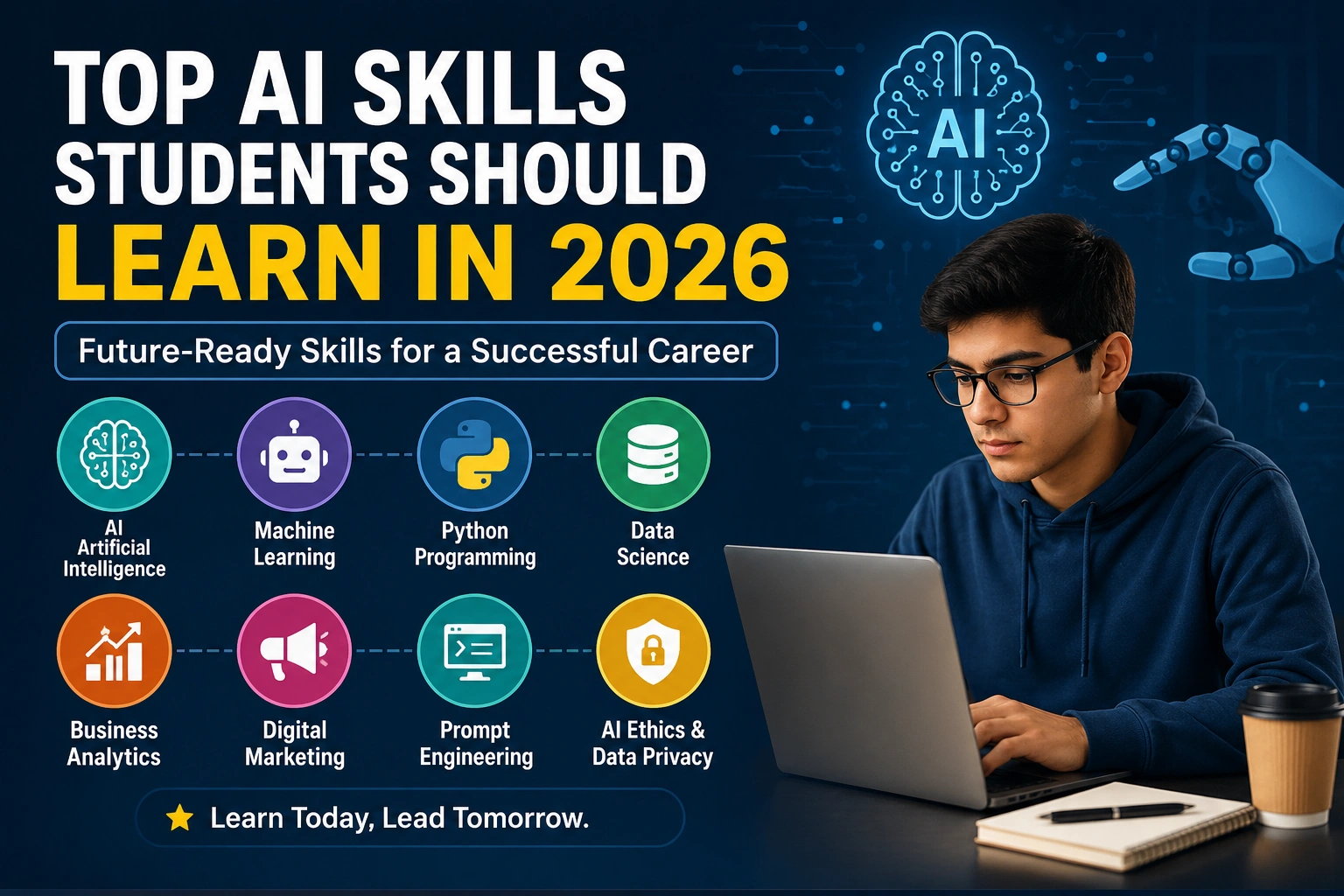
What Is Prompt Engineering?
One of the fastest-growing AI skills is prompt engineering.
A prompt is simply the instruction you give an AI system. However, the quality of the response depends greatly on how clearly and specifically the prompt is written.
For example, instead of asking:
“Write an article about renewable energy.”
A better prompt would be:
“Write a 1,500-word SEO-friendly article on renewable energy in India. Include government policies, market trends, employment opportunities, expert insights, and a conclusion with future prospects.”
The second prompt provides context, structure, and clear expectations, resulting in a much better response.
Professionals who can write effective prompts save time, improve accuracy, and generate higher-quality work.
AI-Powered Research Makes Learning Faster
Research traditionally required reading dozens of reports, articles, and documents before finding relevant information.
Today, AI can summarize complex reports, compare multiple sources, organize information, and explain technical concepts in simple language.
Students can use AI to understand difficult subjects.
Researchers can organize literature reviews.
Journalists can identify background information before conducting interviews.
Business professionals can quickly study competitors and industry trends.
Although AI accelerates research, users should always verify important facts using reliable sources, especially for legal, financial, scientific, or medical information.
Interesting Reads
How artificial intelligence is transforming the world
Communication Skills in Leadership: Why Effective Communication Defines Great Leaders in 2026
AI Content Creation Is Changing Every Industry
Content creation has become one of the largest applications of AI.
Professionals now use AI to create:
- Blog articles
- Marketing copy
- Product descriptions
- Email campaigns
- Social media captions
- Video scripts
- Press releases
- Business reports
- News summaries
- Website content
Instead of replacing writers, AI helps generate first drafts, improve grammar, organize ideas, and optimize content for search engines.
Human editing remains essential to ensure originality, accuracy, tone, and credibility.
The best content combines AI efficiency with human creativity.
AI Coding Assistants Are Helping Developers
Software developers are increasingly using AI coding assistants to improve productivity.
These tools help programmers:
- Generate code snippets
- Detect bugs
- Explain programming concepts
- Suggest improvements
- Convert code between programming languages
- Create documentation
- Improve testing
Rather than replacing software engineers, AI allows developers to spend more time solving complex problems and less time writing repetitive code.
Engineering students who learn to use AI coding assistants effectively can significantly improve their development workflow.
AI Data Analysis Helps Better Decision-Making
Every organization generates large amounts of data.
Analyzing that information manually can be time-consuming.
AI now assists professionals by:
- Identifying trends
- Creating dashboards
- Generating charts
- Forecasting business performance
- Detecting anomalies
- Producing summaries
Finance professionals, marketing teams, HR departments, healthcare organizations, government agencies, and manufacturers increasingly rely on AI-powered analytics to make informed decisions.
Even basic knowledge of Excel, Power BI, SQL, and AI-assisted analysis can greatly improve career opportunities.
Industries Already Using AI
Artificial Intelligence is no longer limited to technology companies.
Today, AI is widely used in:
- Healthcare for medical image analysis and patient support
- Banking for fraud detection and customer service
- Education for personalized learning
- Agriculture for crop monitoring
- Manufacturing for predictive maintenance
- Journalism for research and newsroom workflows
- Retail for customer recommendations
- Logistics for route optimization
- Government services for digital governance
- Cybersecurity for threat detection
As AI adoption continues to grow, professionals who understand these tools will have an advantage across sectors.
Skills That AI Cannot Easily Replace
Despite rapid technological progress, several human abilities remain essential.
These include:
- Critical thinking
- Emotional intelligence
- Leadership
- Creativity
- Negotiation
- Ethical decision-making
- Team collaboration
- Communication
- Innovation
- Strategic planning
AI performs best when it supports human expertise rather than replacing it.
The professionals who succeed in 2026 will combine technical knowledge with these uniquely human strengths.
How Students Can Start Learning AI
Learning AI does not require an advanced computer science degree.
Students can begin by:
- Understanding AI fundamentals.
- Practicing prompt engineering daily.
- Exploring AI-powered writing and research tools.
- Learning Excel and data visualization.
- Taking introductory Python courses.
- Building small AI-assisted projects.
- Following technology news and developments.
- Participating in online communities and hackathons.
Consistent practice is more valuable than trying to master every AI tool at once.
Career Opportunities for AI-Skilled Professionals
Professionals with AI knowledge are increasingly finding opportunities in roles such as:
- AI Content Specialist
- Prompt Engineer
- Data Analyst
- AI Research Assistant
- Digital Marketing Executive
- Business Analyst
- Software Developer
- Cybersecurity Analyst
- Product Manager
- Automation Consultant
Even professionals in non-technical roles can improve productivity and career growth by integrating AI into their daily work.
Looking Ahead
Artificial Intelligence is expected to remain one of the defining technologies of the coming decade. Businesses will continue investing in AI-driven solutions, while educational institutions are incorporating AI literacy into their curricula.
The question is no longer whether AI will influence your career—it already does.
The real question is whether you will adapt and use AI to enhance your capabilities.
Professionals who embrace continuous learning, develop AI skills, and combine technology with creativity and sound judgment will be better prepared for the future workplace.
Conclusion
Artificial Intelligence is not simply another software tool—it represents a new way of working.
From prompt engineering and research to coding, content creation, and data analysis, AI is helping professionals achieve more in less time.
However, success will belong to those who use AI responsibly, think critically, verify information, and continue developing uniquely human skills.
Rather than competing against Artificial Intelligence, learn to work alongside it.
In 2026 and beyond, your greatest career advantage will not be avoiding AI—it will be knowing how to use it effectively.
