
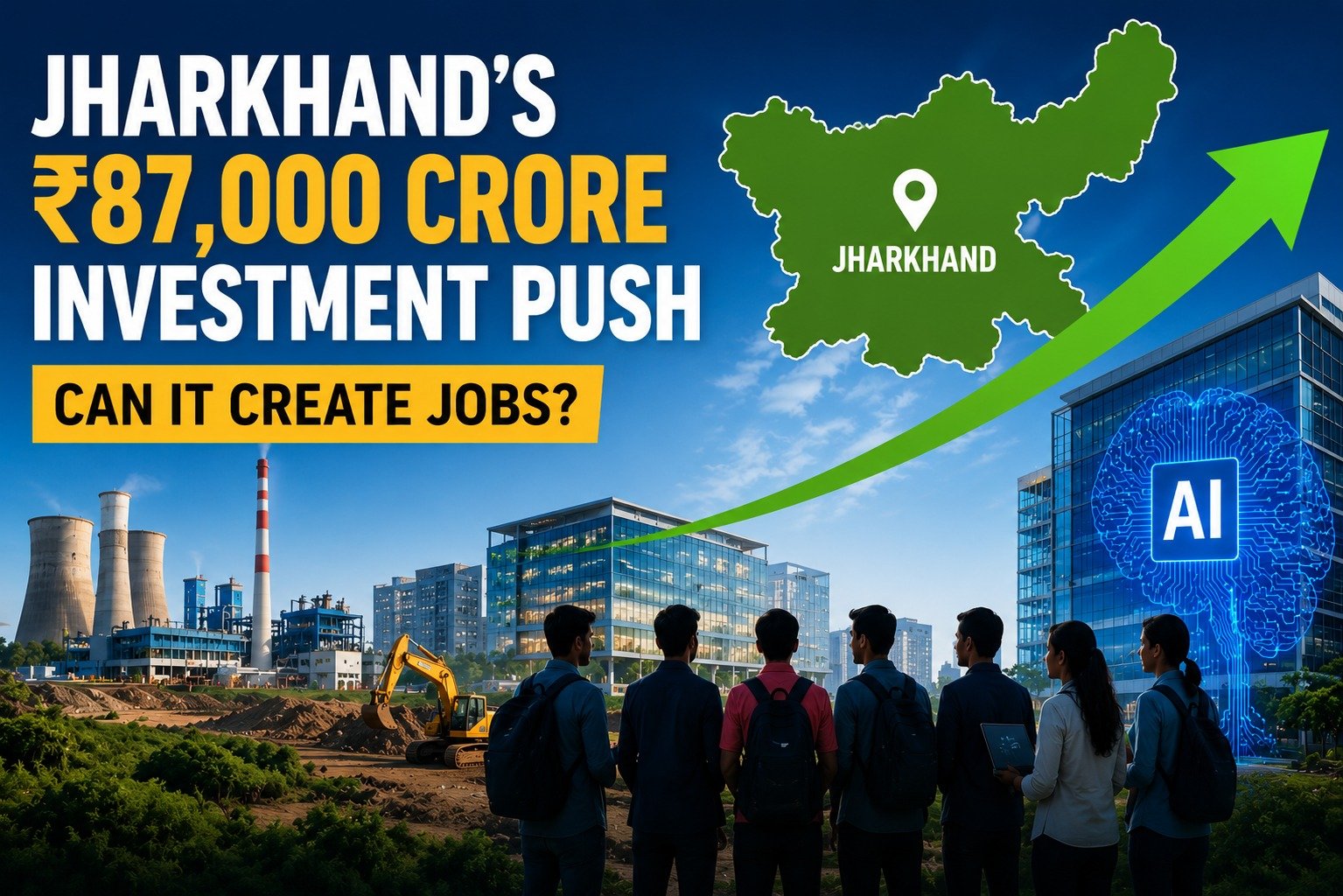
For years, Jharkhand has faced a paradox. The state sits on some of India’s richest coal, iron ore, and mineral reserves, contributes significantly to the country’s industrial output, yet thousands of young people continue to leave every year in search of better employment opportunities.
Now, the state government has announced what could become the largest investment push in Jharkhand’s history.
At the National Stakeholders Consultation 2026 held in New Delhi, Jharkhand signed 14 major MoUs worth ₹99,639 crore, with investments proposed across steel, cement, artificial intelligence, cloud computing, tourism, infrastructure, manufacturing, and digital governance. The initial investment figure of ₹87,000 crore later increased to nearly ₹1 lakh crore as additional agreements were finalized.
For a state where unemployment, migration, and lack of private-sector opportunities dominate public discussions, these announcements have generated both excitement and skepticism.
The question now is simple:
Will these investments create jobs on the ground, or remain announcements on paper?
The Biggest Investments Are Coming from Steel, Cement and Technology
A closer look at the investment commitments shows that heavy industry still dominates Jharkhand’s economic future.
The largest proposal comes from Jindal Steel, which has announced plans to invest ₹40,000 crore in the state. Another major proposal of ₹30,000 crore has come from Ambitious Cement. Tata Steel has proposed expansion projects worth around ₹2,600 crore, while other industrial players have also submitted proposals in manufacturing and infrastructure.
Alongside traditional industries, Jharkhand is attempting something new.
Technology giants and digital ecosystem partners have entered discussions around artificial intelligence, cloud computing, data centres, digital governance, and smart infrastructure. Google has signed an agreement with the state government covering AI, cloud technology, digital transformation, education, healthcare, and governance systems.
For the first time, Jharkhand is positioning itself not only as a mining state but as a future technology destination.
The Real Challenge: Jharkhand’s Job Crisis
The investment announcements come at a time when employment remains one of the biggest concerns across the state.
Whether in Dhanbad, Bokaro, Ranchi, Hazaribagh, Giridih, or Deoghar, a common trend continues: young people leave Jharkhand after graduation.
Many migrate to Bengaluru, Hyderabad, Pune, Delhi, and Mumbai because they believe career opportunities and salaries are better outside the state.
This migration has created a growing frustration among local families.
Parents invest in education, but many graduates ultimately leave Jharkhand because they struggle to find suitable private-sector jobs.
The state’s latest investment drive is being presented as a solution to this long-standing challenge.
However, economists point out that investment announcements alone do not create employment.
Factories must be built.
Industries must start operations.
Recruitment must happen.
Only then will the economic benefits reach ordinary families.
Can AI Really Create One Lakh Jobs?
Perhaps the most ambitious part of Jharkhand’s new strategy is its proposed Artificial Intelligence Policy 2026–31.
The government has proposed an investment of approximately ₹1,150 crore for AI infrastructure and digital transformation. The policy aims to:
- Create more than 1 lakh AI-enabled jobs
- Support over 1,000 startups
- Attract ₹10,000 crore in technology investments
- Establish more than 50 Global Capability Centres (GCCs)
- Develop an AI Park and innovation ecosystem in Ranchi
On paper, the vision is impressive.
But many education experts believe the bigger challenge lies elsewhere.
Do enough young people in Jharkhand currently possess the skills required for AI, cloud computing, cybersecurity, software engineering, and data analytics?
That remains uncertain.
Many colleges continue to focus on traditional curricula while industry demand is rapidly shifting toward emerging technologies.
Without major investments in skill development, there is a risk that companies could recruit experienced professionals from outside the state rather than local youth.
What Local Youth Are Saying
Among students and young professionals, reactions are mixed.
There is excitement about the possibility of technology companies entering Jharkhand.
Engineering graduates see opportunities that did not exist a few years ago.
Many believe the state finally has a chance to reduce its dependence on coal and mining.
At the same time, there is considerable skepticism.
Young job seekers often point to previous investment announcements that failed to produce large-scale employment.
Their concerns are practical:
- When will projects actually start?
- How many jobs will be reserved for local candidates?
- Will salaries be competitive?
- Will companies hire fresh graduates?
For many families, these questions matter more than the headline investment figures.
Interesting Reads
The MoU Problem: Investment Promises vs Ground Reality
The biggest challenge facing the government is execution.
Across India, investment summits frequently generate large announcements. However, not all MoUs translate into actual projects.
Industry experts often describe MoUs as “investment intent” rather than confirmed investment.
Before a project creates jobs, it must pass through multiple stages:
- Land acquisition
- Environmental clearances
- Infrastructure development
- Financing approvals
- Construction
- Operational setup
Only after these stages are completed does recruitment begin.
This means the success of Jharkhand’s investment drive will likely be measured over the next five to ten years rather than the next few months.
Know More About Government News
A Turning Point for Jharkhand
The significance of this investment push goes beyond economics.
For decades, Jharkhand’s identity has been tied to coal mines, steel plants, and mineral wealth.
The government’s new vision seeks to add technology, innovation, tourism, digital services, and advanced manufacturing to that identity.
If even a substantial portion of the ₹99,639 crore investment commitments materialize, Jharkhand could witness one of the largest economic transformations since its formation in 2000.
But if projects remain stuck in paperwork and approvals, public skepticism will only grow.
For now, investors are showing interest.
The state has secured national attention.
The announcements have been made.
The next phase is what matters most:
Turning investment promises into real jobs for Jharkhand’s youth.
