
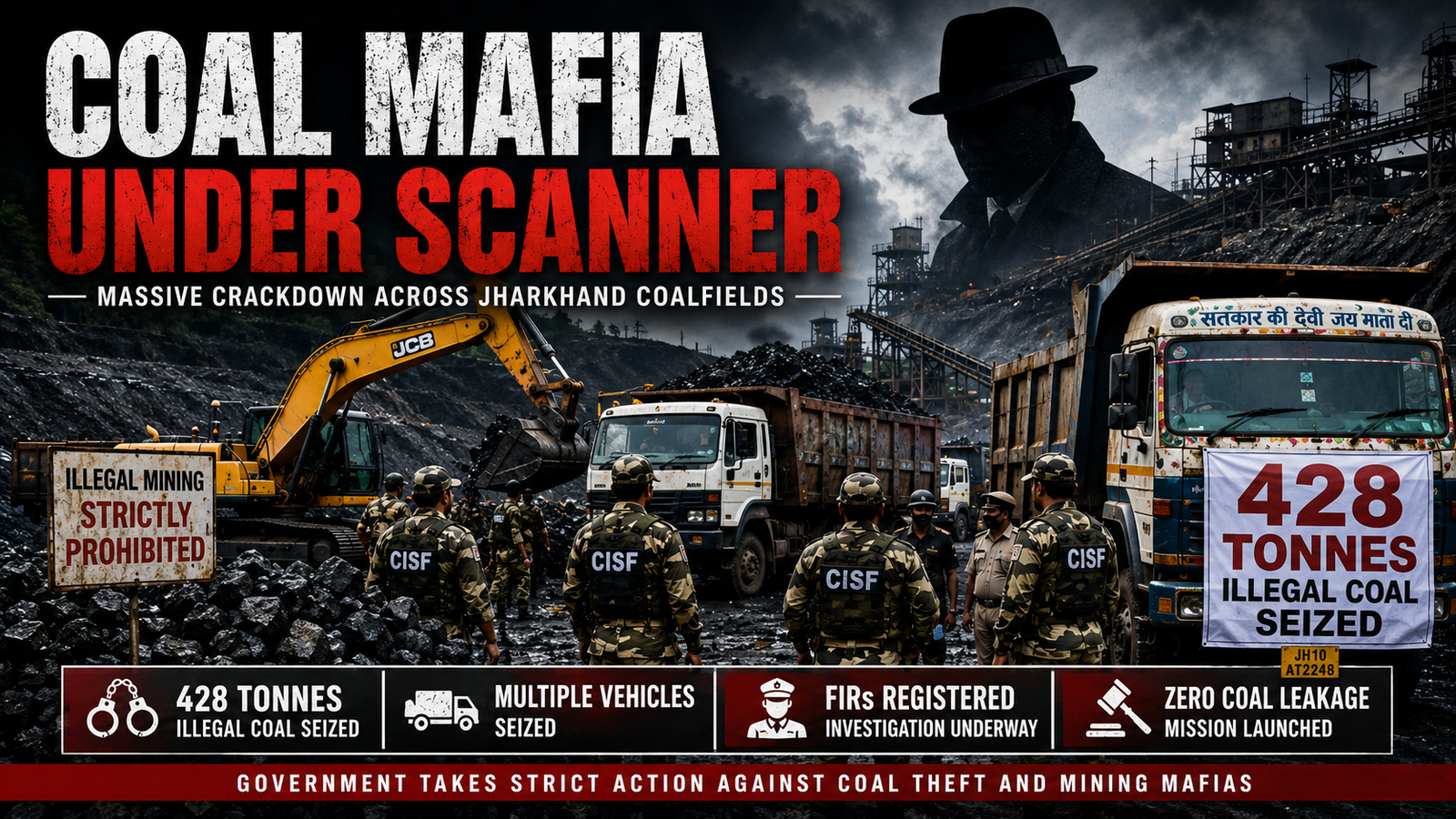
Jharkhand’s coal belt, particularly the Dhanbad-Jharia region, has once again come under the national spotlight after the Central Government launched a major operation against illegal coal mining and transportation. The action follows growing concerns over coal theft, unauthorized mining, and the activities of organized coal smuggling networks operating across several mining areas in the state.
In a significant move, Union Home Minister Amit Shah directed the Central Industrial Security Force (CISF) and the Ministry of Coal to implement a “Zero Coal Leakage Plan” aimed at eliminating coal theft and strengthening security in vulnerable mining zones. The directive came after reports of increasing illegal mining activities in Dhanbad and nearby coal-producing regions.
Special Operation Across Coalfields
Acting on the government’s instructions, CISF launched a coordinated operation between July 4 and July 8, 2026, across coalfields operated by Bharat Coking Coal Limited (BCCL), Central Coalfields Limited (CCL), and Eastern Coalfields Limited (ECL). The operation covered several high-risk areas known for illegal coal extraction and transportation.
During the crackdown, security personnel recovered 428.34 metric tonnes of illegally mined, stored, and transported coal. Authorities also registered four FIRs and seized a Hyva truck, more than 13 motorcycles, and several tools allegedly used for illegal mining operations.
Dhanbad Emerges as Major Focus
The largest recovery was made in the BCCL command areas of Dhanbad. Raids were conducted in Katras, Sijua, Kustore, Jealgora, Govindpur, Barora, and other mining locations. Security teams used intelligence inputs, drone surveillance, field inspections, and route monitoring to identify illegal coal stockpiles. More than 319 metric tonnes of coal were recovered from the Dhanbad region alone.
Additional operations in Rajmahal, Chitra, Salanpur, Sonepur-Bazari, Piparwar, and Kargali resulted in the recovery of nearly 109 metric tonnes of illegally mined coal and the seizure of vehicles used for transportation.
How the Illegal Coal Network Operates
According to security agencies, illegal coal mining often takes place in abandoned mine patches, exposed coal seams, and unsecured areas surrounding active mines. The coal is extracted manually or using small equipment, collected at temporary storage points, and transported through unauthorized routes before being sold in local markets, brick kilns, small industries, and other consumers.
Investigators believe such networks typically involve illegal miners, transport operators, middlemen, and organized groups that profit from coal theft. However, authorities have not publicly released the names of individuals arrested during the latest operation.
Financial Impact
While the government has not released official figures regarding the value of the recovered coal, industry estimates suggest that hundreds of tonnes of coking coal can be worth several lakh to crores of rupees depending on grade and market rates. Officials believe that the recovered quantity represents only a fraction of the coal being illegally extracted and transported through organized networks.
Illegal mining not only causes financial losses to coal companies and the government but also affects royalty collections, mine safety, and environmental management.
Government’s New Strategy
The latest operation marks a major shift in enforcement. Recently, the Central Government empowered CISF officers under provisions of the Mines and Minerals (Development and Regulation) Act (MMDR Act), allowing them to directly conduct search, seizure, and enforcement operations against illegal mining activities.
Under the Zero Coal Leakage Mission, authorities are now using:
- Drone surveillance of mining areas
- Intelligence-based raids
- GPS-enabled monitoring
- Inspection of weighbridges and coal depots
- Verification of transportation documents
- Quick Response Teams (QRTs)
- Multi-layered security arrangements in vulnerable zones
Interesting Reads
What This Means for Jharkhand
Jharkhand accounts for a significant share of India’s coal production and remains the backbone of the country’s energy sector. The success of this crackdown is expected to strengthen transparency in coal transportation, reduce illegal mining, improve safety in mining regions, and protect government revenues.
Officials have indicated that the operation is only the beginning and that similar enforcement drives will continue across coal-producing districts in the coming months. Strict legal action has been promised against anyone found involved in illegal mining, storage, or transportation of coal.
